
Understanding Your Thinking Patterns
Cognitive behavioral therapy (CBT) stands as one of the most researched and widely practiced forms of psychological treatment available today. For individuals navigating anxiety, depression, or other mental health conditions, understanding how this therapy works can be the first step toward meaningful change. Unlike approaches that focus primarily on exploring past experiences or unconscious motivations, CBT emphasizes the connection between thoughts, feelings, and behaviors in the present moment. This practical, structured approach has helped millions of people develop coping skills to manage psychological problems and improve their daily lives.
The foundation of cognitive behavioral therapy rests on a straightforward yet powerful premise: our thoughts affect our feelings, and both influence how we behave. When someone experiences negative thoughts repeatedly, these patterns can contribute to negative emotions and unhelpful behavior. At Balanced Mind Psychotherapy, our CBT therapists work collaboratively with clients to identify these patterns and develop different strategies for responding to challenging situations. This goal-oriented type of treatment has demonstrated effectiveness across numerous emotional health conditions, making it a preferred option for many mental health professionals and the individuals they serve. If you would like to learn more about CBT therapy and whether it is right for you, contact Balanced Mind Psychotherapy today for a free consultation.
What Is Cognitive Behavioral Therapy (CBT)?
Cognitive behavioral therapy, often abbreviated as CBT, represents a form of psychological therapy that addresses the interconnected nature of thoughts, emotions, and actions. Developed through the integration of cognitive therapy and behavioral therapy approaches, this treatment modality recognizes that mental health problems often stem from learned patterns of thinking and behaving that no longer serve us well. Rather than viewing symptoms as purely biological or environmental in origin, cognitive behavior therapy considers how our interpretations of events shape our emotional responses and subsequent actions.
The term “cognitive” refers to the mental processes involved in how we perceive, remember, and interpret information. When someone encounters a stressful situation, their cognitive processes determine how they understand what is happening. These interpretations then influence emotional responses and behavioral choices. For example, someone with anxiety might interpret a friend’s delayed text response as rejection, leading to negative feelings and avoidance behavior. A mental health professional trained in cognitive behavioral therapy (CBT) would help this person examine whether this interpretation reflects reality or represents an unhelpful thought pattern.
The “behavioral” component addresses observable actions and reactions. Behavioral therapy principles suggest that many psychological problems are maintained through reinforcement patterns. When someone avoids anxiety-provoking situations, they experience short-term relief, which reinforces the avoidant behavior. However, this creates long-term difficulties as their world becomes increasingly restricted. Behavior therapy techniques within CBT help individuals gradually face feared situations while learning that anxiety can naturally decrease over time without avoidance.
Core Principles of Cognitive Behavioral Therapy
Several core principles guide how cognitive behavioral therapy operates. First, CBT recognizes that psychological problems are partly based on faulty or unhelpful thinking patterns. These thought patterns might include catastrophizing (assuming the worst will happen), black-and-white thinking (seeing situations as all good or all bad), or overgeneralization (drawing broad conclusions from single events). Research by Dr. Aaron Beck and colleagues at the University of Pennsylvania in the 1960s established that these cognitive distortions contribute significantly to depression and anxiety disorders.
Second, CBT acknowledges that psychological problems are partly based on learned patterns of unhelpful behavior. These behavioral patterns develop over time as individuals attempt to cope with difficult emotions or situations. While these strategies may provide temporary relief, they often create problems in the long run. Someone dealing with social anxiety might avoid gatherings, which prevents them from experiencing social success and reinforces their belief that social situations are threatening.
Third, CBT operates on the principle that people can learn better coping skills and strategies to relieve their symptoms and become more effective in their lives. A highly trained psychotherapist, such as those at Balanced Mind Psychotherapy, helps clients recognize that change is possible through consistent effort and practice. This empowering message resonates particularly well with individuals seeking concrete tools for managing mental health conditions.
The fourth core principle involves the collaborative nature of the therapeutic relationship. Unlike some other therapies where the therapist primarily listens and interprets, a CBT therapist actively works with the client to identify goals, develop treatment strategies, and evaluate progress. This partnership approach respects the client’s expertise about their own life while drawing on the therapist’s knowledge of effective psychological treatment methods.
How CBT Addresses Mental Health Conditions
Anxiety Disorders
Cognitive behavioral therapy (CBT) has demonstrated effectiveness for treating anxiety disorders, including generalized anxiety disorder, panic disorder, and social anxiety disorder. The treatment addresses both the cognitive and behavioral components that maintain anxiety.
On the cognitive side, therapy sessions focus on identifying and challenging negative thought patterns that fuel worry and fear. Someone with panic disorder might believe that a racing heart signals an impending heart attack, creating a cycle of panic. The CBT therapist guides them in examining evidence for and against this interpretation, often revealing that physical anxiety symptoms, while uncomfortable, are not dangerous.
The behavioral interventions for treating anxiety typically involve gradual exposure to feared situations. This evidence-based technique helps individuals learn through experience that their feared outcomes rarely occur and that anxiety decreases naturally without avoidance. Research has found that exposure-based cognitive behavioral therapy produces significant and lasting reductions in anxiety symptoms.
Depressive Disorders
For depression, CBT addresses the negative thinking patterns that characterize this mental illness. Individuals experiencing depression often engage in harsh self-talk, viewing themselves, their circumstances, and their future through an excessively negative lens. The behavioral components of treatment for depression include activity scheduling and behavioral activation, which help people re-engage with potentially rewarding activities even when motivation is low.
Substance Use Disorders
Cognitive behavior therapy helps individuals identify triggers for substance use, develop alternative coping skills, and challenge thoughts that justify continued use. For substance use disorders, CBT teaches people to recognize and avoid situations (sometimes referred to as “people, places, and things”) likely to lead to relapse while also providing tools to cope with cravings and urges.
Other Mental Health Conditions
Other mental health conditions that respond well to CBT include obsessive-compulsive disorder (OCD), post-traumatic stress disorder (PTSD), eating disorders, and, when used in tandem with psychiatric medications, bipolar disorder. The adaptability of CBT principles allows skilled mental health professionals, such as those at Balanced Mind Psychotherapy, to tailor interventions to specific symptoms and circumstances. Even conditions traditionally viewed as primarily medical, such as chronic pain and chronic fatigue syndrome, can benefit from CBT approaches that address the psychological factors influencing symptom experience and functional capacity.
The Structure of CBT Treatment
Cognitive behavioral therapy typically operates as a short-term therapy, with many individuals completing treatment in twelve to twenty sessions. The structured nature makes CBT appealing to many clients compared to longer-term treatments. However, the specific duration depends on the severity of symptoms, the number of mental health problems being addressed, and individual progress.
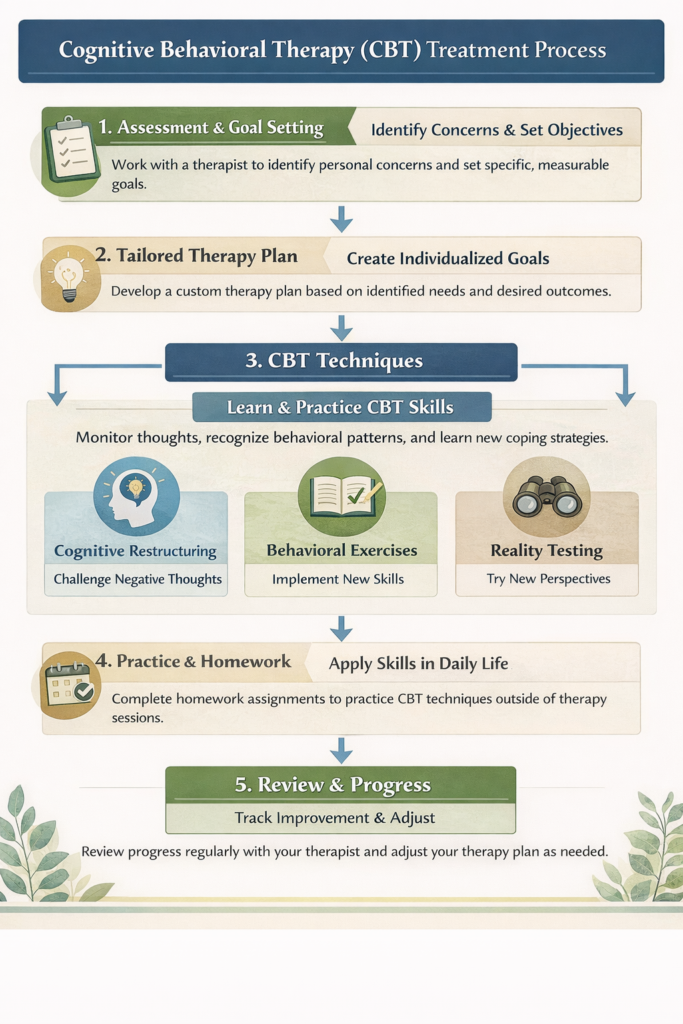
Treatment usually begins with a comprehensive assessment where a compassionate CBT therapist, like those at Balanced Mind Psychotherapy, and the client collaboratively identify specific concerns and establish clear goals. Unlike more exploratory talk therapy approaches, CBT maintains a present-focused orientation. While past experiences may be discussed to understand how current thought patterns developed, the primary emphasis remains on changing present-day thinking and behavior. This practical focus allows for measurable progress toward concrete objectives.
A typical therapy session follows a structured format. The therapist helps clients review progress since the previous meeting, including any homework assignments completed between sessions. Cognitive behavioral therapy involves homework as a central component, not as an optional add-on. These between-session tasks might include keeping thought records, practicing relaxation techniques, or engaging in behavioral experiments. Research indicates that individuals who complete homework assignments experience better outcomes than those who do not.
During sessions, the CBT therapist employs various techniques depending on the individual’s needs. Cognitive restructuring helps people identify and challenge negative thought patterns. The therapist might ask questions like “What evidence supports this thought?” or “Are there alternative ways to interpret this situation?” This engaging therapeutic style helps clients gain insight into their thinking patterns and nurtures positive feelings to replace the negative feelings.
Behavioral experiments form another crucial component of CBT treatment. Rather than just talking about changing behavior, individuals actively test their beliefs through planned actions. Someone afraid of judgment might experiment with deliberately making a small mistake in public to see whether the catastrophic consequences they fear actually occur. These experiences provide powerful evidence that challenges unhelpful thoughts more effectively than verbal reasoning alone.
Techniques Used in Cognitive Behavioral Therapy
One fundamental technique in cognitive behavioral therapy is identifying automatic thoughts. These rapid, reflexive thoughts occur in response to situations and significantly influence emotional responses. Many people are unaware of these thoughts until specifically trained to notice them. A CBT therapist teaches clients to catch these thoughts through self-monitoring exercises. Keeping a thought record, where individuals note situations, accompanying thoughts, emotions, and behaviors, helps reveal patterns that might otherwise remain invisible.
Once automatic thoughts are identified, cognitive restructuring techniques help challenge negative thought patterns. This process does not involve replacing negative thoughts with unrealistically positive ones. Instead, it emphasizes developing more balanced, evidence-based perspectives. Someone who thinks “I always fail at everything” might be guided to recognize times they succeeded and develop a more accurate statement like “I sometimes struggle with certain tasks, but I have succeeded in many areas.”
Behavioral activation serves as a key technique, particularly for depression. This approach involves scheduling activities that provide opportunities for positive experiences and accomplishment. When people feel depressed, they often withdraw from previously enjoyed activities, which further worsens their mood. Behavioral activation breaks this cycle by encouraging gradual re-engagement with meaningful activities, even before motivation returns naturally.
Exposure and response prevention (ERP) therapy represents another essential behavioral therapy technique within the CBT framework. For anxiety disorders, obsessive-compulsive disorder (OCD), and trauma-related conditions, systematic exposure to feared stimuli or situations forms a cornerstone of treatment. Exposure is usually gradual, starting with less frightening situations and scaling to more intensive situations, depending on the specific condition and individual circumstances. The key mechanism involves learning that anxiety decreases without avoidance or safety behaviors.
Relaxation training and stress management techniques provide CBT clients with tools for managing physical symptoms of anxiety and tension. Progressive muscle relaxation and other mindfulness-based strategies help individuals regulate their physiological responses to stress. While not unique to cognitive behavioral therapy, these techniques complement cognitive and behavioral interventions by addressing the physical dimension of emotional challenges.
Problem-solving therapy, integrated within many CBT protocols, teaches a systematic approach to handling challenging situations. This structured method involves defining the problem clearly, brainstorming potential solutions without initially judging them, evaluating options based on likely outcomes, implementing a chosen solution, and reviewing results. Learning to solve problems effectively reduces feelings of helplessness and increases confidence in managing daily life stressors.
What to Expect When Working with a CBT Therapist
Finding the right therapist involves considering several factors. Mental health professionals who provide CBT include psychologists, licensed clinical social workers, and mental health counselors. Many professional directories allow searching specifically for providers offering cognitive behavioral therapy. In the New York City area, numerous psychiatric clinics and private practices specialize in CBT, including Balanced Mind Psychotherapy.
During initial sessions, a CBT therapist will gather information about your mental health history, current symptoms, and treatment goals. This assessment phase helps determine whether cognitive behavior therapy is appropriate for your concerns. While CBT works well for many mental health conditions, some situations may benefit from other forms of treatment or a combination of approaches. A skilled mental health professional will discuss these options honestly and may provide alternative recommendations if another treatment approach seems more suitable.
The collaborative relationship in cognitive behavioral therapy means that you will actively participate in treatment planning and implementation. Your therapist will explain the rationale behind suggested techniques and seek your input about what seems most relevant to your situation. This transparency helps build trust and ensures that treatment addresses your most pressing concerns. Unlike some other therapies where the treatment process remains somewhat mysterious, CBT focuses on explicit explanations of how and why particular interventions work.
Sessions typically occur weekly, though frequency may vary based on symptom severity and practical considerations. Between-session work represents a crucial element that distinguishes cognitive behavioral therapy from purely supportive counseling. Expect to spend time outside therapy sessions practicing new skills, completing thought records, and engaging in behavioral experiments.
Progress in cognitive behavioral therapy can often be measured objectively through symptom questionnaires and goal attainment tracking. Many therapists use standardized assessments periodically throughout treatment to monitor change. This data-driven approach helps both therapist and client recognize improvements that might otherwise go unnoticed amid day-to-day fluctuations. It also allows for treatment adjustments if progress stalls.
Is CBT Right for You?
Determining whether cognitive behavioral therapy suits your needs involves considering several factors. CBT works best for individuals willing to actively participate in treatment through homework assignments and between-session practice. If you value learning concrete skills and seeing measurable progress relatively quickly, CBT may align well with your preferences.
The time-limited nature of CBT appeals to many people but may not suit everyone. Some individuals prefer ongoing supportive therapy without a predetermined endpoint. Others appreciate knowing that treatment will likely conclude within a specific timeframe, making short-term treatment like CBT attractive. Discussing your preferences with a mental health professional can help determine the best approach.
Cognitive behavioral therapy requires acknowledging the connection between thoughts, feelings, and behaviors. While this may seem self-evident, some individuals find it challenging to examine their thinking patterns or question long-held beliefs about themselves and the world. The compassionate and skilled CBT therapists at Balanced Mind Psychotherapy will work at a pace that feels manageable while still encouraging growth beyond your comfort zone.
Your specific mental health concerns influence whether cognitive behavioral therapy represents the optimal choice. For anxiety disorders, depression, obsessive-compulsive disorder (OCD), and many other mental health problems, research strongly supports CBT as a first-line treatment. For other conditions, it may work well as part of a comprehensive treatment plan that includes additional interventions. A thorough evaluation with a qualified mental health professional helps clarify which approach or combination of approaches will best address your unique situation.
Taking the Next Step
Understanding how cognitive behavioral therapy works provides a foundation for making informed decisions about your mental health care. This evidence-based approach offers practical tools for managing negative emotions, changing behavioral patterns, and improving overall functioning. Whether you are experiencing anxiety, depression, or other emotional challenges, cognitive behavioral therapy has likely helped others with similar concerns develop more effective ways of thinking and behaving.
Beginning treatment involves finding a qualified provider who practices CBT in a format that works for you. Many providers, such as Balanced Mind Psychotherapy, offer free, 15-minute consultations to explore your unique symptoms and concerns to determine if CBT is an ideal therapy for you at that time. During initial sessions, you and your therapist will clarify goals, develop a treatment plan, and begin learning the skills that make cognitive behavioral therapy effective. While many clients experience positive changes after just a few sessions, most individuals benefit from a complete course of treatment to ensure lasting change.
The journey through cognitive behavioral therapy involves both challenge and growth. Examining unhelpful thoughts and facing feared situations requires courage. However, the structured support of a skilled CBT therapist, combined with evidence-based techniques refined over decades of research, provides a clear path toward improved mental health and a more satisfying daily life. Taking that first step toward treatment represents an investment in your well-being that research suggests will yield meaningful returns.
How Do I Pay For CBT?
Balanced Mind Psychotherapy is a private pay practice and does not accept insurance. We believe in providing individualized, high-quality care without the restrictions or limitations often associated with insurance-based treatment.
If you have out-of-network benefits, we’re happy to provide a superbill upon request, which you can submit directly to your insurance provider for potential reimbursement. Please consult your provider to understand your coverage and eligibility for out-of-network mental health services.
Contact Details for Balanced Mind Psychotherapy Therapists
Please contact us at [email protected] or 718-690-2005 to schedule an appointment and take the first step toward a healthier you.