
How Do I Find a Therapist for Non-Monogamous Couples In New York?
Relationships come in many forms. Some couples choose monogamous relationships, while others explore open relationships, polyamory, or other non-traditional relationships. No matter the relationship structure, healthy communication is what holds things together. This is especially true for people practicing ethical non-monogamy, where multiple relationships and different feelings need to be discussed openly and honestly. An experienced couples therapist can help partners strengthen communication skills, work through jealousy or insecurity, and keep the relationship strong while navigating the complexities of non monogamous relationships.
At Balanced Mind Psychotherapy, we offer couples therapy for all kinds of relationship styles, including open and polyamorous relationships. Our therapists understand that ethical non-monogamy is not one size fits all, and we create a supportive space for every partner involved. If you are exploring ethical non-monogamy or already practicing it, we would love to help. Schedule a free consultation today to see how we can support your relationship.
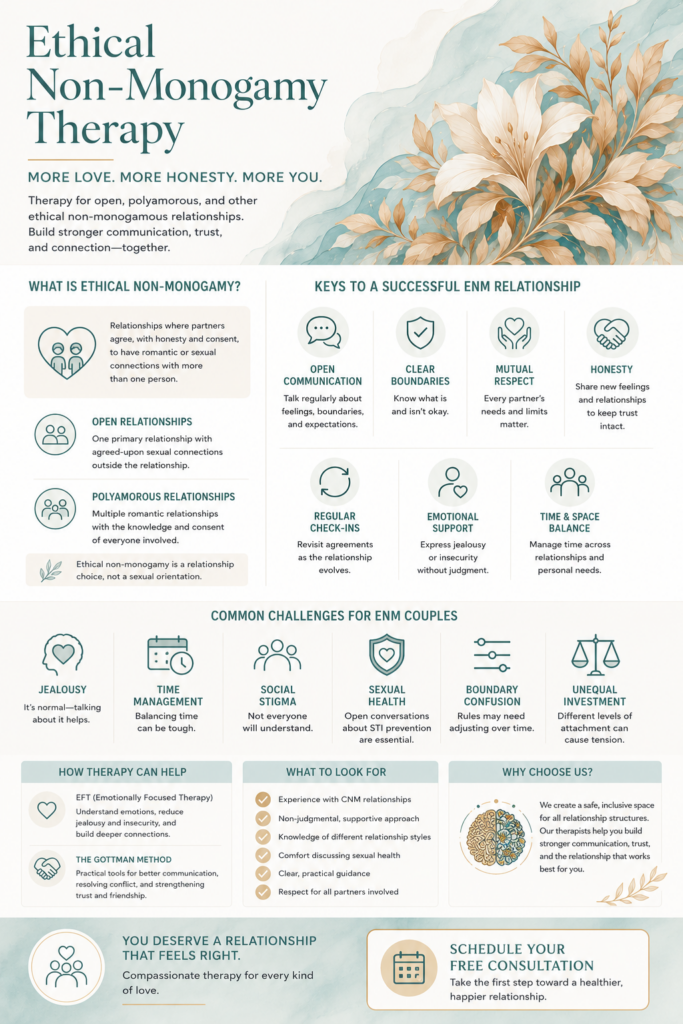
What Is Ethical Non-Monogamy?
Ethical non-monogamy (often shortened to ENM) describes relationships where partners agree, with honesty and consent, to have romantic or sexual connections with more than one person. The word “ethical” matters here. It means every person involved knows what is happening and agrees to it. This sets consensual non-monogamy apart from cheating or dishonesty.
Ethical non monogamous relationships can look different depending on the people involved. Two common styles are open relationships and polyamorous relationships.
Open Relationships
In an open relationship, partners usually have one primary relationship and agree that one or both people can have sexual connections with others outside the relationship. Emotional intimacy often stays focused on the primary partner, while physical intimacy may extend to others.
Polyamorous Relationships
Polyamory involves having multiple romantic relationships at the same time, with the knowledge and consent of everyone involved. Unlike open relationships, polyamorous relationships often include emotional bonds with more than one partner, not just physical ones. Some people also identify with relationship anarchy, which rejects set rules about how relationships should look and instead lets each connection develop on its own terms.
It is worth noting that ethical non-monogamy is a relationship choice, not a sexual orientation. People of any sexual orientation may choose monogamous relationships or non monogamous relationships based on what fits their life and values.
What Are the Keys To a Successful Non-Monogamous Relationship?
Every relationship takes work, but non monogamous relationships often need a few extra tools to thrive. Here are some keys to success:
Open communication. Partners need to talk regularly about feelings, boundaries, and expectations.
Clear boundaries. Knowing what is and is not okay helps prevent hurt feelings later on.
Mutual respect. Every partner’s needs and limits deserve to be honored.
Honesty. Sharing new relationships, feelings, or concerns keeps trust intact.
Regular check-ins. Revisiting agreements as the relationship changes keeps everyone on the same page.
Emotional support. Partners should feel comfortable expressing jealousy or insecurity without judgment.
What Are Some Common Challenges for Ethical Non-Monogamous Couples?
Even with good communication, monogamous and CNM relationships alike face challenges. Non monogamous couples often deal with a few specific issues:
Jealousy. Feelings of jealousy can come up even when everyone has agreed to the relationship structure.
Time management. Balancing time between multiple relationships can be difficult.
Social stigma. Friends or family may not understand or support non-traditional relationships.
Sexual health concerns. With more partners involved, sexual health and prevention of sexually transmitted infections become an important topic to discuss openly.
Boundary confusion. Rules that felt fine at first may need adjusting as relationships grow or change.
Unequal investment. One partner may feel more involved or attached than another, which can create tension.
How Can a Couples Therapist Help with Ethical Non-Monogamy?
A couples therapist trained in navigating ethical non-monogamy can help partners talk through hard topics in a calm, supportive space. Therapy gives everyone involved a chance to be heard and to work through relationship dynamics without blame. Two approaches that work well for ethical non monogamous relationships are Emotionally Focused Therapy (EFT) and the Gottman Method.
EFT for Ethical Non-Monogamy
EFT focuses on the emotional bonds between partners. In non-monogamy therapy, EFT can help partners understand the feelings behind jealousy or insecurity, rather than just reacting to them. This approach helps couples build a stronger emotional connection, even when that connection is shared among more than two people.
The Gottman Method for Ethical Non-Monogamy
The Gottman Method focuses on practical tools for communication and conflict resolution. For couples navigating challenges in non monogamous relationships, this method offers structured ways to discuss boundaries, resolve disagreements, and build friendship and trust between partners.
What Should I Look For In a Therapist For My Non-Monogamous Relationship?
Not every therapist has experience with ethical non-monogamy. Here is what to look for when choosing the right fit:
Experience with CNM relationships. Look for a therapist who has worked with open, polyamorous, or other non monogamous relationships before.
A non-judgmental approach. Your therapist should offer a supportive space without pushing personal opinions about relationship choices.
Knowledge of different relationship styles. A good therapist understands that open relationships, polyamory, and relationship anarchy all have different needs.
Comfort discussing sexual health. Since sexual health and STI prevention often come up, your therapist should be comfortable addressing these topics directly.
Clear, practical guidance. Look for a therapist who offers real tools, not just generic advice.
Respect for all parties involved. Every partner should feel equally respected and included in sessions when appropriate.
Why Should I Choose Balanced Mind Psychotherapy?
At Balanced Mind Psychotherapy, our therapists have experience supporting couples of all relationship structures, including those exploring ethical non-monogamy for the first time and those who have practiced it for years. We know that every relationship is different, and we take the time to understand your specific situation, whether you are in an open relationship, a polyamorous relationship, or another non-traditional relationship.
We offer a supportive space where every partner involved can speak honestly and work toward stronger communication and mutual respect. Our goal is to help you build the relationship that works best for you and the people you love. Schedule a free consultation with Balanced Mind Psychotherapy today and take the next step toward a healthier, stronger relationship.