
What Can Emotion-Focused Therapy Do For Me?
Every relationship goes through rough patches. But for many couples, the struggle runs deeper than occasional disagreements. It feels like something has quietly slipped away — the warmth, the ease, the sense of truly being known by your partner. Research consistently shows that emotional disconnection is one of the most common reasons couples seek therapy. When partners stop feeling safe sharing their inner world, small conflicts can spiral into lasting distance.
There are many reasons emotional connection fades. Life transitions like having children, career changes, or loss can pull partners in different directions. Old wounds from past relationships can trigger reactions that neither partner fully understands. Communication patterns harden over time, and what started as a minor misunderstanding can become a wall. Sometimes one partner withdraws while the other pursues, creating a painful cycle that leaves both people feeling alone.
Emotion-focused therapy (EFT) was developed specifically to address these patterns. Rather than teaching communication scripts or conflict management techniques in isolation, EFT goes to the root of disconnection. It helps partners understand the emotional experiences driving their behavior, rebuild trust, and create a deeper, more secure bond. For many couples, EFT offers a genuine path toward stronger relationships and lasting change.
At Balanced Mind Psychotherapy, our licensed therapists specialize in emotion-focused therapy for couples. We work with partners at all stages, whether you are in the middle of a painful cycle and need help finding a way out, or simply want to build a stronger and more connected relationship before small issues become bigger ones. We offer a free initial consultation so you can get a feel for our approach and ask any questions before committing to a first session. Schedule your free consultation with Balanced Mind Psychotherapy today and take the first step toward reconnecting with your partner.
What Is Emotion-Focused Therapy?
Emotion-focused therapy is a structured, evidence-based approach developed in the 1980s by Dr. Sue Johnson and Dr. Les Greenberg. It draws on attachment theory — the idea, rooted in clinical psychology, that humans are wired to seek close emotional bonds and that distress often signals a threat to those bonds. When we feel our attachment is at risk, our emotional responses can become intense, reactive, and hard to understand.
EFT helps people identify, explore, and reshape how they experience and express their emotions. The goal is not to suppress or analyze feelings from a distance, but to work through them in a way that leads to healing and connection. Today, EFT is recognized by the American Psychological Association as an empirically supported treatment, and the International Centre for Excellence in Emotionally Focused Therapy (ICEEFT) trains and certifies EFT therapists worldwide.
How Emotion-Focused Therapy Works for Couples
In couples therapy, EFT focuses on identifying the negative patterns that keep partners stuck. These cycles, often called “demon dialogues,” usually involve one partner pursuing connection through criticism or demand, while the other withdraws or shuts down. Both responses come from the same place: fear of losing the other person.
An EFT therapist helps each partner slow down and access the vulnerable emotions beneath these surface reactions. Feeling angry or frustrated often masks deeper feelings of hurt, fear, or shame. When couples can share those softer emotions safely, partners are able to respond with compassion rather than defensiveness. Over time, the cycle shifts. The second stage of EFT focuses on building new patterns of reaching out and responding, creating a more secure emotional foundation.
How Emotion-Focused Therapy Works for Families
Emotion-focused family therapy applies the same principles to family systems. Whether it involves parent-child conflict, sibling tension, or the strain of a family navigating a major life change, EFT work in a family context helps members recognize how their emotional responses affect one another. Families learn to move from reactive, defensive interactions toward more open and connected ones. This approach is especially helpful when a young person is struggling emotionally, and family dynamics are playing a role in their well-being.
What Can I Expect In Emotion-Focused Therapy Sessions?
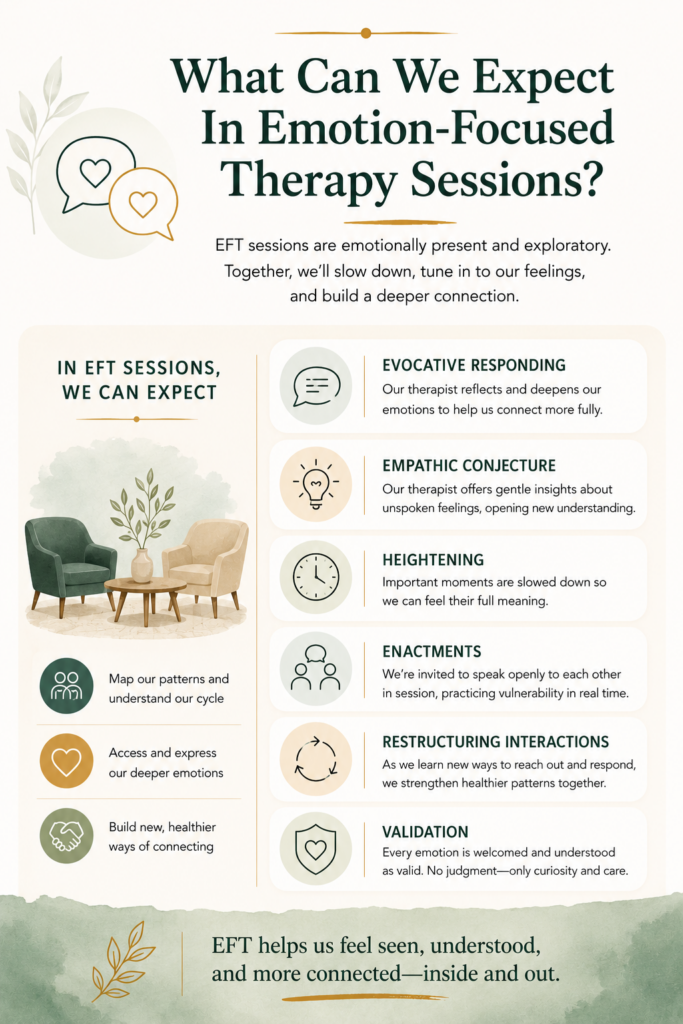
EFT sessions feel different from many other forms of therapy. Rather than focusing primarily on problem-solving or psychoeducation, sessions are emotionally present and exploratory. Your therapist will guide you to slow down and pay attention to what is happening inside you, not just what you are thinking, but what you are feeling in your body and heart.
In early sessions, you and your therapist will work together to map out the negative patterns in your relationship or family. You will begin to see how each person’s emotional experiences and responses fit together, and how the cycle, not any one person, is often the real problem. As therapy progresses, sessions become more focused on helping each person access and express deeper emotional experiences in a safe and supported way.
Common emotion-focused therapy techniques include:
- Evocative responding: Your therapist reflects and deepens your emotional experience using carefully chosen language that helps you connect with feelings that may be hard to access on your own.
- Empathic conjecture: The therapist makes gentle, educated guesses about unspoken feelings, helping you explore emotional territory that might feel unfamiliar or unsafe.
- Heightening: Key emotional moments are slowed down and highlighted so that their full meaning can be felt and processed, rather than bypassed.
- Enactments: You are invited to speak directly to your partner or family member in session, practicing new ways of expressing vulnerable emotions in real time.
- Restructuring interactions: As you and your partner or family learn new ways of reaching out and responding, the therapist helps you consolidate these healthier ways of connecting.
- Validation: Every emotional response is treated as understandable given your history and experience. There is no judgment, only curiosity and care.
The pace of EFT is gentle and collaborative. Most people find that having a skilled therapist witness and support their emotional experiences is itself a powerful part of the healing process.
What Should I Look For In an Emotion-Focused Therapist?
Finding the right therapist matters. EFT is a specialized approach, and working with someone who is properly trained makes a meaningful difference in outcomes. Here is what to look for:
Specialized Training in EFT
Look for a therapist who has completed formal EFT training, ideally through a certified EFT training program or the International Centre for Excellence in Emotionally Focused Therapy. Many licensed mental health professionals have general couples or family therapy experience, but EFT requires specific training in the model’s theory and techniques.
Licensure and Credentials
Your therapist should hold a current license as a mental health professional, such as a licensed clinical social worker (LCSW), licensed professional counselor (LPC), licensed marriage and family therapist (LMFT), or psychologist. This ensures they meet professional and ethical standards in their state.
Experience with Your Specific Concern
Whether you are seeking individual therapy to work through attachment wounds, couples therapy to rebuild connection, or emotion-focused family therapy for a family in distress, look for a therapist with relevant experience. Do not hesitate to ask during an initial consultation about their background with your particular situation.
A Good Therapeutic Fit
EFT involves exploring vulnerable emotions, which means the relationship with your therapist matters enormously. A good EFT therapist will feel warm, curious, and nonjudgmental. You should feel genuinely heard from the very first session. Many therapists offer a brief consultation call, which is a good opportunity to get a sense of the fit before committing.
Ongoing Consultation and Professional Development
Skilled EFT therapists continue to grow in their practice. Look for someone who participates in ongoing supervision or consultation, attends EFT conferences or trainings, and stays current with research in the field. You can also search for certified EFT therapists through an EFT therapist directory like the one maintained by ICEEFT.
Balanced Mind Psychotherapy | Emotion-Focused Therapy
At Balanced Mind Psychotherapy, we believe that emotional health is at the heart of a fulfilling life and meaningful relationships. Our team of licensed mental health professionals is trained in emotionally focused therapy and committed to providing compassionate, evidence-based care to individuals, couples, and families across New York.
We understand that reaching out for help takes courage. Whether you are struggling with emotional disconnection in your relationship, navigating family conflict, or working through painful emotional patterns from your past, our therapists are here to support you with skill, warmth, and genuine care. We work collaboratively with each client to understand their unique emotional experiences and goals, and to create a therapeutic space where real change can happen.
EFT is not a quick fix, but it is one of the most effective paths toward lasting transformation in relationships and emotional well-being. Many of our clients describe their work with us as a turning point — the place where they finally began to feel understood and where their most important relationships began to heal.
If you are ready to take the first step, we would love to connect with you. Schedule your consultation with Balanced Mind Psychotherapy today and find out how emotion-focused therapy can help you build the connections and the emotional well-being you deserve.