
How Can We Break Zero-Sum Dialogue Patterns in Couples Therapy?
Few things are more exhausting than a fight with your partner that feels like someone has to lose. You each dig in, the tension builds, and instead of solving the problem, you end up further apart than when you started. This is what zero-sum dialogue does to a relationship: it frames every conflict as a win-lose situation, where one person’s gain automatically becomes the other’s loss. Over time, this way of thinking breaks down communication and makes it nearly impossible to move forward together. The good news is that a licensed couples therapist can help you and your partner find a healthier, more connected way to work through disagreements.
At Balanced Mind Psychotherapy, we offer couples therapy designed to help partners build stronger relationships through open communication and healthy conflict resolution. Our therapists work with you to identify the patterns that keep you stuck and replace them with tools that actually bring you closer. If zero-sum dialogue is affecting your relationship, we encourage you to schedule a free consultation today.
What Is Zero-Sum Dialogue?
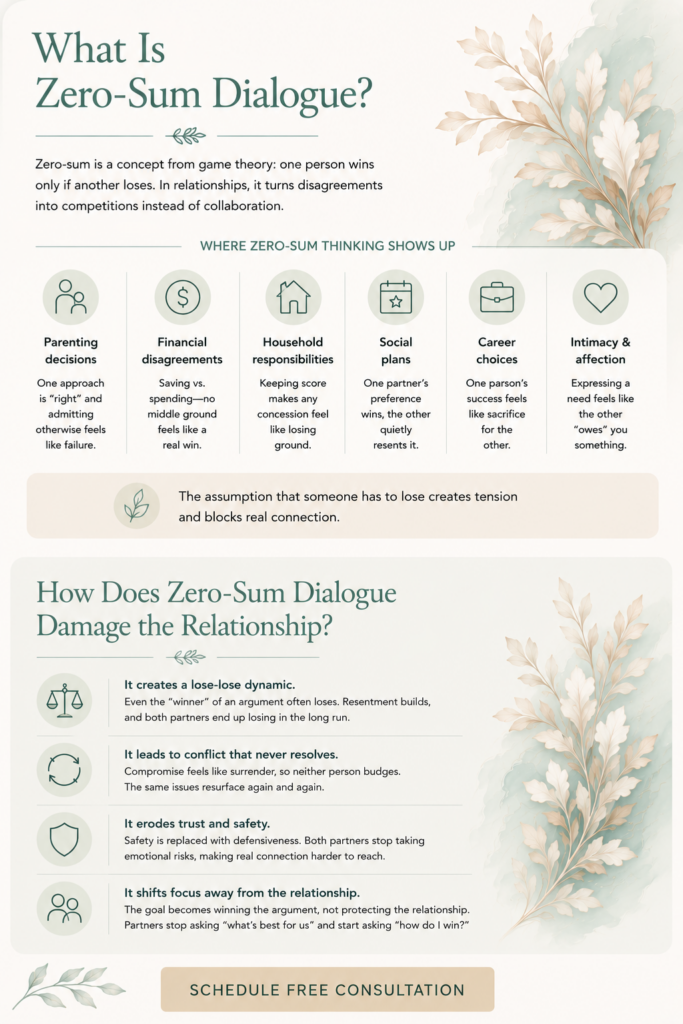
Zero-sum is a concept from game theory describing situations where one player wins only if another loses. The total outcome always adds up to zero; there’s no possibility of both sides benefiting. What one person gains, the other has to give up.
When this thinking shows up in a relationship, it turns everyday disagreements into competitions. Instead of two people working together toward a solution, it becomes one person’s win versus another’s loss. Every conversation starts to feel like a battle, and every compromise like a defeat.
Zero-sum thinking tends to show up in a few recurring places.
Parenting decisions. One partner insists their approach is right, and agreeing with the other feels like admitting failure.
Financial disagreements. One person wants to save while the other wants to spend, and neither sees a middle ground as a genuine win.
Household responsibilities. Keeping score of who does more, so any concession feels like losing ground.
Social plans. One partner’s preference wins out, and the other quietly resents it.
Career choices. One person’s advancement seems to require sacrifice from the other, and neither perspective gets fully honored.
Intimacy and affection. One partner feels that expressing a need means the other “owes” them something in return.
In each of these, the assumption that someone has to lose creates unnecessary tension that blocks real connection.
How Does Zero-Sum Dialogue Damage the Relationship?
Zero-sum dialogue doesn’t just make fights harder. It gradually wears away at the foundation of a relationship, and the cumulative effect can be serious.
It creates a lose-lose dynamic. The biggest irony of zero-sum thinking is that even the partner who “wins” an argument often loses something important. Their partner feels unheard, resentment builds, and bad feelings linger long after the conversation ends. Over time, both people end up losing, even when it felt like someone came out ahead in the moment.
It leads to conflict that never resolves. When two people are locked in a zero-sum mindset, compromise starts to feel like surrender, so neither person is willing to be the one who budges first. Because nobody moves, the same topics resurface again and again without ever actually getting resolved.
It erodes trust and safety. A relationship depends on both people feeling safe enough to be vulnerable. Zero-sum dialogue replaces that safety with defensiveness. When one partner’s win always comes at the other’s loss, both stop taking emotional risks with each other, and genuine connection becomes harder to reach.
It shifts focus away from the relationship. In a zero-sum dynamic, the goal becomes winning the argument rather than protecting the relationship. Partners stop asking what’s best for us and start asking how do I come out ahead, one of the most damaging long-term effects of this kind of thinking.
How Do We Stop Using Zero-Sum Dialogue and Find a Healthier Solution?
The alternative to zero-sum is a non-zero-sum, or win-win, approach, where one person’s gain doesn’t have to come at the other’s loss. Both partners can come out of a conflict feeling heard, respected, and closer to each other.
Moving from zero-sum to non-zero-sum dialogue takes practice, but it’s entirely achievable.
Name the pattern when it’s happening. Simply recognizing “we’re in a zero-sum loop right now” can slow the conversation down and create room for a different approach.
Shift the goal from winning to understanding. Before making your point, try to genuinely understand your partner’s. Ask questions. Listen without planning your rebuttal.
Use “both/and” language instead of “either/or.” Instead of “it’s my way or yours,” explore how both needs might be honored in some form. This reframes the conversation from competition to collaboration.
Separate the person from the position. Disagreeing with your partner’s idea isn’t the same as rejecting them as a person. Keeping that distinction clear reduces defensiveness and keeps the dialogue open.
Identify shared values and goals. Most couples, even mid-fight, actually want the same things at a deeper level: security, respect, love, stability. Returning to shared values can cut through surface-level conflict.
Take breaks before the conversation escalates. Zero-sum thinking intensifies when emotions run high. A short pause can prevent a win-lose fight from turning into a blow-up that takes days to recover from.
Practice repair attempts. After a difficult conversation, small gestures of reconnection matter. A repair attempt is any effort to ease tension and signal that the relationship comes first.
Why Should We Work With a Couples Therapist To End Zero-Sum Dialogue?
Changing deeply ingrained communication patterns is genuinely difficult. Most people don’t even realize they’re engaging in zero-sum dialogue until it has already done lasting damage. Working with a couples therapist brings structure, safety, and expertise to the process.
A therapist provides neutral ground. When both partners are in the middle of a conflict, it’s nearly impossible to see the full picture from inside it. A therapist offers an outside perspective that neither person can provide alone, helping both feel heard without feeling like the other is winning.
A therapist helps identify the root causes. Zero-sum dialogue often runs deeper than communication style. It can be rooted in attachment patterns, past experience, fear of vulnerability, or unspoken needs. Understanding why the pattern developed in the first place makes it much easier to change.
A therapist teaches practical skills. Insight alone doesn’t change behavior. A skilled couples therapist teaches specific tools partners can use in everyday life, not just in the therapy room, tools that build over time and create lasting change.
A therapist helps navigate high-stakes conversations. Some topics, like finances, parenting, or intimacy, carry so much weight that even well-intentioned couples struggle to discuss them productively. A therapist provides a structured space to work through these conversations without them turning into zero-sum battles.
A therapist supports both partners equally. Zero-sum thinking can make one partner feel like the “problem” in the relationship. A good therapist helps both people see that the pattern, not either individual, is what needs to change, a shared framing that’s essential for genuine progress.
Balanced Mind Psychotherapy | In-Person and Virtual Couples Therapy
At Balanced Mind Psychotherapy, we understand how deeply zero-sum dialogue can affect a relationship. We also know that with the right support, couples can learn to move from conflict to connection. Our licensed therapists specialize in helping partners identify unhealthy communication patterns, understand what drives them, and build a more collaborative, fulfilling relationship.
We offer both in-person and virtual couples therapy, so it’s easy to get support in a way that fits your life. There’s no win-lose scoreboard in our approach, just two people learning to work as a team again, with guidance along the way.
If zero-sum dialogue is getting in the way of the relationship you want, take the first step. Schedule a free consultation with Balanced Mind Psychotherapy and find out how couples therapy can help you and your partner build something stronger together.