
Can Couples Overcome Compatibility Issues?
Picture this: you and your partner are at the kitchen table, disagreeing about finances. Again. Last week it was how you spend your free time. Before that, it was family obligations. Different topic, same standoff, like you’re working from two different rulebooks for how life is supposed to go. Lately it’s started to feel like maybe you’re just too different to make this work.
If that sounds familiar, you’re far from alone. Most couples hit stretches where the same arguments seem to circle back endlessly. Having real differences, though, doesn’t automatically mean you’re incompatible. In many cases, the friction has less to do with who you are as people and more to do with how you’re communicating, or failing to. Differences in values, priorities, and communication styles are genuinely workable when both partners are willing to put in the effort.
At Balanced Mind Psychotherapy, our licensed therapists work with couples to build the communication skills and emotional tools needed to bridge those gaps. Couples therapy isn’t just for relationships in crisis. It’s for any two people who want to understand each other better and find a path forward together. If you and your partner keep hitting the same walls, we invite you to schedule a free consultation with our team today.
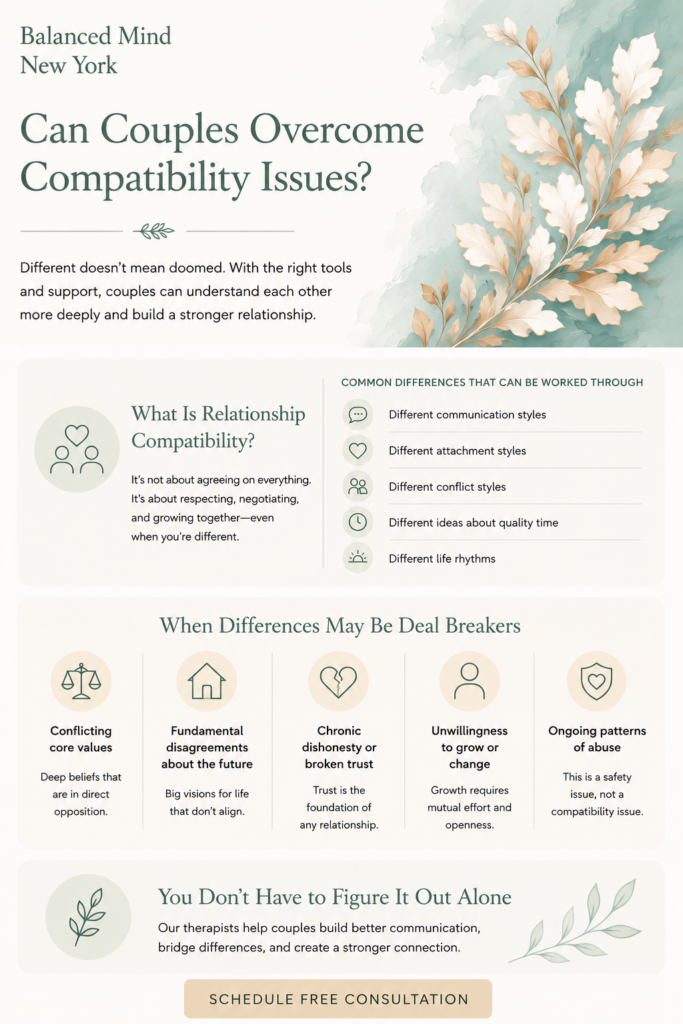
What Is Relationship Compatibility?
The word “compatibility” gets thrown around a lot, and it’s often misunderstood. Many people assume it means you and your partner naturally agree on everything, want the same things, and never clash. That’s not what a healthy relationship actually looks like, and it’s not a realistic standard for any two real people.
True compatibility is less about being identical and more about being able to function well together, especially when you’re different. It’s the ability to respect, negotiate, and grow alongside someone whose experiences and perspectives don’t match your own.
Some of the most common things couples worry are dealbreakers turn out to be entirely workable with the right support.
Different communication styles. One partner may be a talker who processes feelings out loud. The other may need quiet time to think before responding. This difference can create real frustration, but it doesn’t mean the relationship can’t work. Learning each other’s communication rhythms is a skill, and it can be developed.
Different attachment styles. Attachment styles, which shape how people give and receive love and how they respond to closeness or distance, are often rooted in early life experience. Someone with an anxious attachment style may crave frequent reassurance, while someone with an avoidant style may pull back under pressure. These patterns can collide in painful ways, but with awareness and guidance, couples can learn to meet each other’s needs more effectively.
Different conflict styles. Some people lean into disagreement and want to resolve things right away. Others shut down or withdraw. Neither style is wrong, but together they can create a cycle where one partner feels dismissed and the other feels overwhelmed. Understanding your conflict styles helps you stop fighting about how you fight.
Different ideas about quality time. One partner might recharge through shared activities and togetherness. The other might need more alone time or independent interests. Learning to honor both needs, without one person feeling left out or the other feeling crowded, is entirely possible.
Different life rhythms. Work schedules, social needs, sleep habits, and energy levels all affect daily life together. These are practical challenges to work through, not signs of fundamental incompatibility.
While many differences can be resolved, there are some situations where two people may genuinely struggle to build a fulfilling life together. These are real deal breakers, not just bumps in the road.
- Conflicting core values. Core values are not the same as preferences. They are the deep beliefs that guide how you make decisions and what you want your life to stand for. If one partner wants children and the other doesn’t, or if your values around religion, ethics, or family are in direct opposition, finding middle ground can be genuinely difficult.
- Fundamental disagreements about the future. Where you want to live, whether to have children, how you define financial security, and what role work plays in your identity are not small topics. When one partner’s vision for the future is sharply at odds with the other’s, that gap can be hard to close.
- Chronic dishonesty or broken trust. A relationship needs a basic level of trust to function. When patterns of dishonesty persist over time, rebuilding that trust becomes a much harder, longer process, even with committed support.
- Unwillingness to grow or change. Couples therapy works when both people are willing to show up and try. If one partner is consistently unwilling to reflect, take responsibility, or engage, it becomes very difficult to make progress.
- Ongoing patterns of abuse. Emotional, physical, or controlling behavior is not a compatibility issue. It’s a safety issue, and it calls for a different kind of intervention.
How Can My Partner and I Resolve Compatibility Issues?
The good news is that most couples, even those who feel stuck, have more room to grow than they realize. Here are some approaches that can make a real difference.
Learn how to listen without planning your response. One of the most common patterns in relationships is listening to reply rather than listening to understand. When your partner feels genuinely heard, conversations tend to de-escalate and move forward more productively.
Name your feelings before your complaints. Saying “I feel left out when we don’t spend evenings together” lands very differently than “You never make time for me.” Leading with feelings rather than accusations keeps the conversation from turning into a debate about who’s right.
Identify the pattern, not just the moment. Most recurring arguments aren’t really about the dishes or the credit card bill. They’re about underlying needs, like feeling respected, feeling secure, or feeling like a priority. When you can name the deeper pattern, you can start to address it directly.
Find small agreements before tackling big ones. Building a habit of collaboration on smaller decisions makes it easier to approach harder topics as a team rather than as opponents.
Give yourself and your partner room to be imperfect. Change in a relationship is rarely linear. You’ll both have setbacks. What matters is whether you’re both trending in the right direction.
How Will a Couples Therapist Help Us Overcome Compatibility Issues?
Working with a therapist brings structure and guidance to conversations that often go in circles on their own. Here is what you can expect from the process.
A neutral, informed space. A therapist is not on anyone’s side. They help both partners feel heard and offer perspective that neither person can easily provide from inside the relationship.
Identifying underlying patterns. Couples therapists are trained to spot the cycles that keep partners stuck. Once those patterns are visible, they become much easier to interrupt and change.
Practical communication tools. You’ll learn specific skills for expressing needs, managing conflict, and repairing after arguments. These aren’t abstract ideas. They’re techniques you can use in your daily life right away.
Understanding attachment and history. Much of what drives conflict in a relationship has roots in earlier experience. A therapist helps you both understand where your responses come from, which makes it easier to respond to each other rather than react to old wounds.
Realistic goal-setting. Therapy isn’t about finding someone fully compatible with you in every way, because that person doesn’t exist. It’s about building a relationship where you and your partner can navigate your differences with respect and skill.
Balanced Mind Psychotherapy | Couples Therapy Offered Online and In-Office
At Balanced Mind Psychotherapy, we understand that reaching out for help takes courage. Our team of licensed therapists brings years of experience in psychotherapy, including specialized support for couples navigating compatibility issues, communication breakdowns, and recurring conflict.
We offer couples therapy through secure telehealth sessions as well as in-person visits at our New York office, so you can access support in whatever way works best for your lives. Whether you’re in the same room or in different cities, our therapists will meet you where you are.
Our approach is practical, compassionate, and shaped around your specific dynamic rather than a script we apply to every couple. We take the time to understand what’s actually going on between you and help you build a relationship that works for both of you.
If you and your partner are ready to stop cycling through the same arguments and start building something better, we’re here to help. Schedule your free consultation with Balanced Mind Psychotherapy today.