
Gottman Method and Emotion-Focused Therapy: A Power Couple For Couples Therapy
Every couple runs into rough patches. Whether it’s recurring arguments, growing emotional distance, or a sense that you and your partner are no longer speaking the same language, relationship distress is more common than most people realize. The good news is that effective, evidence-based help exists.
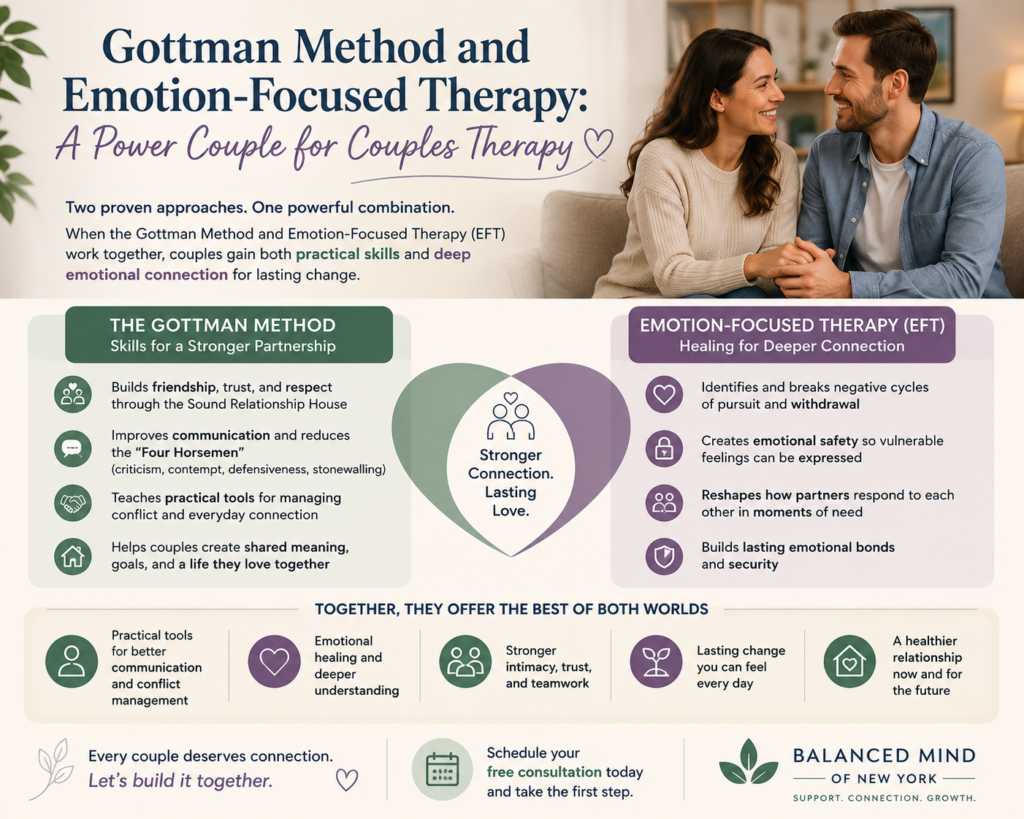
Two of the most widely used and well-researched approaches in couples therapy today are the Gottman Method and Emotion-Focused Therapy (EFT). On their own, each offers a powerful set of tools for improving relationship satisfaction and strengthening emotional connection. When used together, they create a comprehensive framework that addresses both the behavioral patterns that hurt relationships and the deeper emotional wounds that drive them. Combining the Gottman Method and Emotion-Focused Therapy gives couples practical skills for day-to-day communication alongside a deeper understanding of what they truly need from each other.
At Balanced Mind Psychotherapy, our therapists are trained in both approaches and know how to draw on each one to meet your relationship where it is. Whether you’re navigating a specific conflict or feeling a broader disconnection from your partner, we can help. Schedule a free consultation today to take the first step toward a healthier, more fulfilling relationship.
What Is the Gottman Method?
The Gottman Method is a research-based approach to couples counseling developed by Drs. John and Julie Gottman. Over decades of studying thousands of couples, they identified the specific behaviors and communication patterns that predict whether a relationship will thrive or fall apart. Their findings form the foundation of a structured, skills-focused model of couples therapy.
At the heart of the Gottman Method is the Sound Relationship House Theory, a framework that describes the building blocks of a healthy relationship. Think of it as a blueprint: each “floor” of the house represents a key component of partnership, from friendship and admiration to conflict management skills and shared meaning.
Goals of the Gottman Method
- Reduce negative communication patterns (what the Gottmans call the “Four Horsemen”: criticism, contempt, defensiveness, and stonewalling)
- Build a stronger foundation of friendship, trust, and respect
- Improve communication skills so partners can express needs and listen effectively
- Develop conflict management skills that allow disagreements to happen without causing lasting damage
- Create shared meaning and goals that give the relationship a sense of purpose
Key Techniques Used in the Gottman Method
- Love Maps: Exercises that help partners deepen their knowledge of each other’s inner worlds, including dreams, worries, and daily experiences
- Turning Toward: Building the habit of responding to each other’s small bids for attention and connection throughout daily life
- The Four Horsemen Antidotes: Replacing harmful communication habits with healthier ones (for example, using gentle startup instead of criticism, or taking a self-soothing break instead of stonewalling)
- Dreams Within Conflict: A technique that helps couples understand the deeper hopes, values, and fears beneath their recurring arguments
- Physiological Self-Soothing: Tools for calming the body during heated moments so partners can stay present and engaged rather than shutting down
- Rituals of Connection: Intentional routines that strengthen emotional intimacy and keep couples feeling like a team
The Gottman Method’s emphasis on the Sound Relationship House gives couples a clear, concrete map for building and maintaining a healthy relationship over time.
What Is Emotion-Focused Therapy?
Emotion-Focused Therapy (EFT) for couples was developed by Dr. Sue Johnson in the 1980s and is grounded in attachment theory. The core idea is that the emotional bonds between partners are the foundation of a relationship, and that most relationship distress comes from feeling emotionally unsafe or disconnected from the person you depend on most.
Emotionally focused therapy EFT views conflict not as a communication problem to be solved but as an expression of unmet attachment needs. When partners feel threatened or abandoned, they fall into predictable cycles of pursuit and withdrawal that keep them stuck and in pain. EFT helps couples step out of those cycles and rebuild emotional safety and closeness.
Goals of Emotionally Focused Therapy (EFT)
- Help partners recognize and understand the negative cycle they are caught in
- Create emotional safety so that vulnerable feelings can be expressed and received
- Strengthen emotional bonds by reshaping how partners respond to each other at moments of need
- Support partners in reaching for connection rather than reacting from fear or hurt
- Build lasting emotional closeness and security in the relationship
Key Techniques Used in Emotion-Focused Therapy
- Tracking the Cycle: The therapist helps the couple identify their repetitive negative interaction pattern and understand what each partner is feeling beneath the surface behavior
- Evocative Responding: The therapist reflects and deepens partners’ emotional experiences to help them access and express feelings that have been hidden or suppressed
- Empathic Conjecture: Gently naming emotions that a partner may not yet have words for, helping them feel understood and opening new possibilities for connection
- Restructuring Interactions: Creating new moments of emotional responsiveness in session, often called “enactments,” where partners practice turning toward each other with vulnerability and care
- Consolidation: Helping the couple integrate their new ways of relating and apply them to ongoing challenges
Emotionally focused couples therapy is one of the most researched approaches in the field, with strong evidence showing it helps couples move from relationship distress to genuine emotional closeness.
What Are the Key Differences Between the Gottman Method and Emotion-Focused Therapy?
While both approaches aim to help couples build stronger, more fulfilling relationships, they differ meaningfully in their focus and methods. Understanding these differences helps explain why using both can be so valuable.
- Focus: The Gottman Method primarily focuses on behaviors, communication patterns, and friendship. EFT focuses on underlying emotions, attachment needs, and the negative cycles that disconnect partners.
- Theoretical foundation: The Gottman Method is built on the Sound Relationship House Theory and decades of observational research. EFT is rooted in attachment theory and the idea that emotional bonds are central to human well-being.
- Approach to conflict: The Gottman Method offers specific conflict management skills and tools for navigating disagreements productively. EFT explores what the conflict is really about at an emotional level, looking beneath the argument to the attachment fear underneath.
- Session style: Gottman-based sessions tend to be more structured and skill-focused, with specific exercises and psychoeducation. EFT sessions are more exploratory and emotion-focused, following the couple’s emotional experience in the moment.
- Primary target: The Gottman Method targets the quality of the friendship and partnership layer of a relationship. EFT targets the security and depth of the emotional bond.
- Practical tools vs. emotional processing: Gottman therapy tends to provide more tangible, take-home practical tools. EFT creates powerful in-session emotional experiences that shift how partners see and respond to each other.
How Can Both the Gottman Method and Emotion-Focused Therapy Be Used Together In Couples Therapy?
Because the Gottman Method and EFT address different but complementary aspects of relationship health, they work exceptionally well in combination. A therapist trained in both can move fluidly between them depending on what a couple needs at any given moment in the therapeutic process.
For example, a couple might come in locked in a recurring argument about finances. On the surface, it looks like a practical disagreement. An EFT lens helps the therapist track the negative cycle: one partner pursues and criticizes, the other withdraws and shuts down. Through emotionally focused therapy, the couple begins to see that the pursuing partner is actually terrified of being unimportant, and the withdrawing partner shuts down out of shame and fear of failure. Once that emotional truth is on the table, the relationship dynamics shift. Partners can begin to reach for each other instead of triggering each other.
Then, Gottman tools come in to help them sustain that shift in daily life. The therapist might introduce the concept of “softened startup,” so the pursuing partner can raise concerns without triggering defensiveness. They might teach the withdrawing partner to use a structured self-soothing break rather than stonewalling. Over time, the couple builds both the emotional safety that EFT creates and the communication skills the Gottman Method provides.
Another example: a couple who once felt close but now feel more like roommates. EFT helps them identify that emotional intimacy faded gradually as small moments of disconnection went unaddressed. Gottman techniques like Love Maps and rituals of connection give them concrete ways to rebuild that closeness week by week.
In this way, both the Gottman Method and EFT work together to address relationship challenges from the inside out and the outside in. EFT changes the emotional environment of the relationship. The Gottman Method gives couples the skills to maintain and build on that change.
How Does the Gottman Method and EFT Work Together?
One of the reasons EFT and the Gottman Method work so well together is that they focus on different but equally important dimensions of relationship distress. The Gottman Method helps couples understand the content of their conflicts by distinguishing between solvable problems and perpetual problems. Solvable problems are specific issues that can be addressed through practical communication and problem-solving skills, while perpetual problems stem from deeper differences in personality, values, needs, or life experiences and require ongoing dialogue rather than complete resolution. EFT, by contrast, focuses on the process underneath those conflicts by identifying the negative interaction cycle that keeps partners stuck. Instead of concentrating primarily on what couples are arguing about, EFT helps them understand how they are relating to each other in moments of disconnection, fear, or vulnerability. Together, these approaches provide a more complete picture of relationship distress: Gottman helps couples understand the nature of the problem, while EFT helps them transform the emotional cycle that keeps the problem alive.
This combination can be particularly valuable in more complex cases, such as chronic conflict, attachment injuries, infidelity recovery, trauma-related relationship difficulties, or long-standing patterns of emotional disconnection. EFT helps create the emotional safety needed for deeper healing, while Gottman provides concrete tools for navigating difficult conversations and maintaining progress outside of therapy sessions. By addressing both the emotional process and the practical realities of relationship challenges, therapists can help couples create meaningful and lasting change.
Do All Couples Therapists Use the Gottman Method and Emotion-Focused Therapy?
Not every couples therapist is trained in both the Gottman Method and emotionally focused therapy EFT. Some therapists are certified or highly trained in one approach, some use elements of both without full specialization, and others work from entirely different frameworks. Training in either approach requires dedicated coursework, supervised practice, and ongoing professional development.
If you are looking for a therapist who can draw on both the Gottman Method and EFT, it is worth doing a little research before scheduling an appointment. Here are some helpful steps:
- Ask directly: When contacting a therapist, ask whether they are trained in the Gottman Method, EFT, or both, and how they integrate these approaches in their work
- Check credentials: The Gottman Institute offers levels of certification, and EFT therapists may be trained or certified through the International Centre for Excellence in Emotionally Focused Therapy (ICEEFT)
- Look for specialization in couples work: A therapist who focuses specifically on couples counseling is more likely to have in-depth training in these methods than a generalist
- Ask about their approach to your concerns: A good therapist should be able to describe how they would approach your specific situation using these frameworks
- Trust your initial consultation: Many therapists offer a free or low-cost first session. Use it to assess whether their approach, training, and style feel like a good fit for both you and your partner
- Look for ongoing training: Therapists who prioritize continuing education are more likely to offer current, evidence-based care
Finding a therapist who blends both approaches thoughtfully can make a meaningful difference in how quickly and deeply you and your partner experience change.
Balanced Mind Psychotherapy | Couples Therapy That Fits Your Relationship
At Balanced Mind Psychotherapy, we believe that every couple deserves therapy that is tailored to their unique relationship dynamics, not a one-size-fits-all formula. Our therapists bring expertise in both the Gottman Method and Emotion-Focused Therapy, allowing them to offer an integrated approach that addresses both the practical and emotional dimensions of your relationship.
Our team is experienced in working with couples at all stages, including those navigating communication breakdowns, emotional disconnection, infidelity, life transitions, and the slow drift that can happen when life gets busy. We work with couples of all backgrounds, orientations, and relationship structures, and we bring both clinical skill and genuine compassion to every session.
Whether you are hoping to rebuild emotional intimacy, develop healthier communication patterns, or simply reconnect with your partner, we can help you find a path forward. Our goal is not just to reduce conflict but to help you build the kind of relationship where both of you feel seen, valued, and deeply connected.
Taking the first step can feel daunting, but it does not have to be. Schedule a free consultation with Balanced Mind Psychotherapy today and let us help you and your partner start building a more fulfilling relationship together.