
Parents ask me about format more than almost any other practical question, and they usually ask it as a trade. Online is easier. In person is better. How much better, and is it worth the afternoon?
It is a fair way to frame it, and most families now have enough experience of video calls, often from a year or two of remote school, to have a strong feeling about it already. Some children were fine on a screen. Some children spent those years with the camera off and their attention somewhere else entirely.
What I have come to think is that the question is slightly misframed. Online and in-person therapy are not better or worse versions of the same thing. Some parts of a child’s treatment genuinely need the room. Many do not. The useful question is which parts of your child’s treatment are which, and whether your home can hold the parts that happen there.
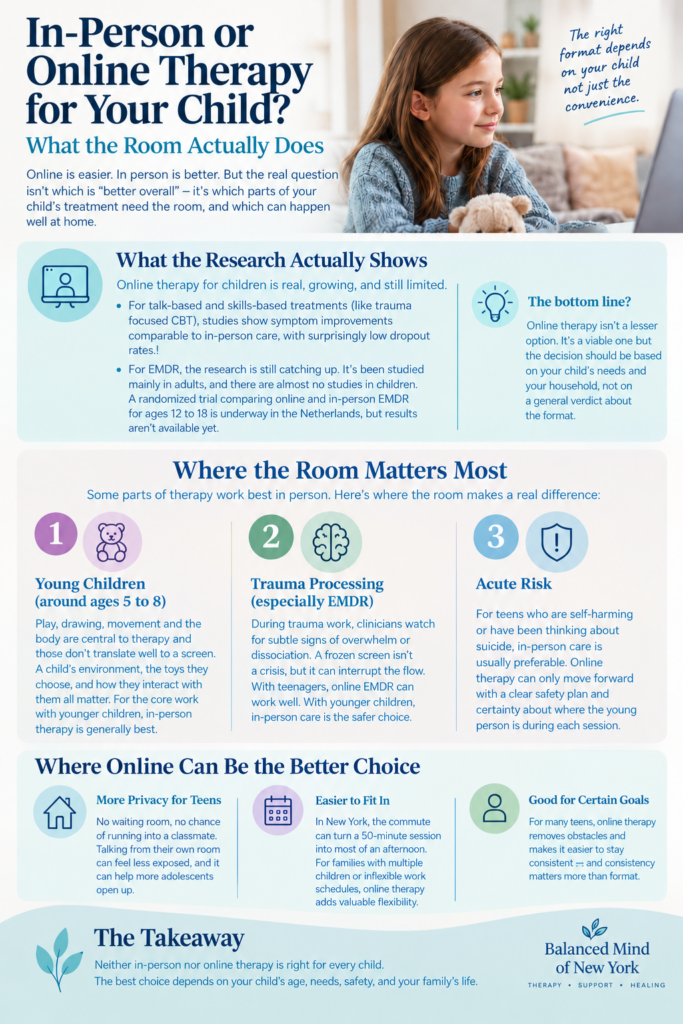
What the research actually shows
The evidence for online therapy with children is real, growing, and thinner than practice websites tend to suggest.
For talk-based and skills-based treatments, the picture is encouraging. Small studies of trauma-focused cognitive behavioral therapy delivered by video have found symptom improvements comparable to office-based care, and unusually low dropout. In one pilot study of fifteen children, not a single family left treatment early, against dropout rates that often run to a third or more in office-based trauma treatment. Those are small samples, though, and large randomized comparisons of video and in-person therapy in children remain few.
For EMDR specifically, the honest answer is that the research has not caught up. Online EMDR has been studied mainly in adults, and a 2023 systematic review of remote EMDR found almost no studies in children at all. A randomized trial comparing online and in-person EMDR for young people aged twelve to eighteen is underway in the Netherlands, but it has not yet been reported. So when a clinician tells you EMDR works just as well online for your child, that claim rests on clinical experience and sensible adaptation rather than on trial data. It may well be true. It has not yet been shown.
None of that means online treatment is a lesser option. It means the decision should be made on the specifics of your child and your household rather than on a general verdict about the format.
Where the room matters most
The first place is with young children. A five-year-old’s therapy is carried largely by drawing, play, movement, and the body, and much less by conversation. Those things translate to a screen imperfectly. Attention drifts faster on video; the therapist cannot hand anything over, and a lot of what a clinician reads in a young child is below the shoulders and outside the frame. Online work with young children is possible, usually with a parent sitting close by, and it often works well for some parts of treatment. Play therapy in particular depends on the room itself: the materials a child chooses, what they reach for and what they avoid, how they arrange things and what they return to week after week. A child playing in their own bedroom on a video call is doing something different. For the core of the work with children around five to eight, I generally prefer the room.
The second is the part of trauma treatment where a memory is actually being processed. During those sessions, a clinician is watching closely for signs that a child is becoming overwhelmed or drifting away from the present, and some of those signs are subtle. A frozen screen at the wrong moment is not a disaster, but it is not nothing either. EMDR can be adapted for video, with the young person tapping their own shoulders or knees in place of a therapist’s hand, or following movement on the screen. With teenagers, who can track their own state and tell you what is happening, that adaptation tends to work well. With younger children I think the case for the room is strong enough that at our practice we do EMDR with children in person and offer it online only to adolescents. Even with a teenager, if they tend to dissociate, or early in treatment before the clinician knows how that particular young person signals distress, in-person sessions are the safer ground.
The third is acute risk. For a teenager who is actively self-harming or has been thinking about suicide, in-person care is generally preferable, and online treatment should only go ahead with a clear safety plan and certainty about where the young person is during each session.
Where online can be the better choice
For many teenagers, online therapy removes more obstacles than it creates. There is no waiting room where a classmate might see them. Talking from their own room, at a slight remove, can feel less exposed than sitting across from an adult they barely know. Some adolescents who would never have tolerated the drive to an office will open a laptop.
Consistency matters too, and more than format. In New York, the trip to an appointment can turn a fifty-minute session into most of an afternoon, and families with more than one child, or parents with inflexible jobs, end up missing sessions. A child who is seen every week on video is usually better served than one who is seen in person two weeks out of three.
Some kinds of work translate especially well. Sessions with parents alone, which make up a real share of good child therapy, work very naturally online. Skills-based treatment such as dialectical behavior therapy teaches concrete material and translates well to video. And family therapy online has an advantage of its own: family members can join from different places, which matters when parents live in two households or one is often traveling, and a glimpse of the family’s actual home can tell a therapist something the office never would.
The problem of the thin wall
Here is the practical issue that gets less attention than it deserves, particularly in this city.
Online therapy happens at home, and many homes do not have a room where a teenager can speak without being overheard. A sibling on the other side of a door, a parent in the next room, an apartment where every conversation carries. For some kinds of therapy, that is an inconvenience. For trauma work, it can be decisive. An adolescent who suspects they can be heard will manage what they say, and material that is being managed does not get processed.
It is often solvable. Headphones help. So does a parent taking younger siblings out for the hour, or a teenager taking the session from a parked car or a quiet room somewhere other than home. But if there is genuinely nowhere private, that is a strong reason to choose the office.
With young children, the logic runs the other way. They usually need a parent close at hand during online sessions, both to help with the technology and as a source of steadiness, so the question is less whether the room is private and more whether a parent can reliably be present for the hour.
Doing both
Families often treat this as a single decision made at the start. In practice, many of the best arrangements combine the two.
A common pattern is to begin in person for the assessment and the first sessions, while the relationship is being built and the clinician is learning how this child works, and then move some or most sessions online once that foundation is there. Another is to keep processing sessions in person and do preparation and parent sessions by video. Switching formats partway through treatment is normal, and it is worth revisiting whenever a family’s circumstances change.
What to ask a prospective clinician
Ask whether they deliver this particular treatment online routinely, with children your child’s age, rather than occasionally. Ask how they adapt it for video, and what happens if the connection drops in the middle of a difficult moment. If your child is a teenager, ask how they handle safety planning for online sessions. And ask about cost plainly. Our practice is out of network, as many private practices in Manhattan are. If you plan to use out-of-network benefits, check with your insurer what they reimburse and whether telehealth sessions are covered on the same terms as office visits, since plans vary.
If you are weighing the options
At Balanced Mind Psychotherapy, we see children and adolescents in person on the Upper East Side and online anywhere in New York State. Our clinicians working with young people include an EMDR clinician who sees children from age five upward, in person for younger children and in person or online for teenagers, along with a marriage and family therapist, clinicians trained in dialectical behavior therapy, and clinicians who offer play therapy. If you are trying to work out which format suits your child, that is a perfectly good reason for a free consultation, and the answer may well be some of each.
Frequently asked questions
Is online therapy as effective as in-person therapy for children?
For many talk-based and skills-based treatments, small studies have found similar outcomes, though large randomized comparisons in children are still limited. The better question for most families is whether a particular child, with a particular treatment, in a particular home, will do well online. Young children and some parts of trauma treatment tend to go better in the room.
Can EMDR be done online with a child?
It can be adapted for video, but the research on online EMDR with young people is very limited, and it rests mainly on clinical experience. At our practice, we offer online EMDR to teenagers, who can tap for themselves and describe what they are noticing, and do EMDR with younger children in person.
Is my child too young for online therapy?
There is no fixed age, but the younger the child, the more the work depends on play, drawing, and physical presence, all of which are harder on a screen. Online sessions can still work for younger children with a parent close by, and sessions with parents alone work well online at any age.
Does my child need to be in New York for online sessions?
Generally yes. Clinicians are licensed by state, so your child will usually need to be physically in New York State at the time of each online session. If you travel often, raise it early so sessions can be planned around it.
Can we switch between in-person and online partway through?
Yes, and many families do. A common arrangement is to start in person and move some sessions online once treatment is established, or to keep the most demanding sessions in the office and do the rest by video.
Do you take insurance?
We are an out-of-network practice. Many families use their plan’s out-of-network benefits, so it is worth calling your insurer to ask what they reimburse for outpatient therapy and whether online sessions are covered on the same terms as in-person ones.