
Most parents who call me about a child open with some version of the same sentence. I don’t know if this is a phase.
It is a reasonable thing not to know. Children change constantly, and much of what looks alarming in a given month is development doing its ordinary work. A six-year-old who suddenly will not sleep alone. A ten-year-old who cries over homework. A fourteen-year-old who has stopped speaking at dinner. Most of it passes, and parents know that, which is exactly what makes the uncertainty so hard to resolve. Nobody wants to turn an ordinary stage into a diagnosis, and nobody wants to be the parent who waited a year too long.
Lists of warning signs help less than they seem to. Nearly every item on them, from irritability to poor sleep to stomachaches to slipping grades, also turns up in children who are fine. What separates a phase from a problem is rarely which symptom you are seeing. It is how long it has lasted, how much of the child’s life it has reached, and whether there was a before and an after.
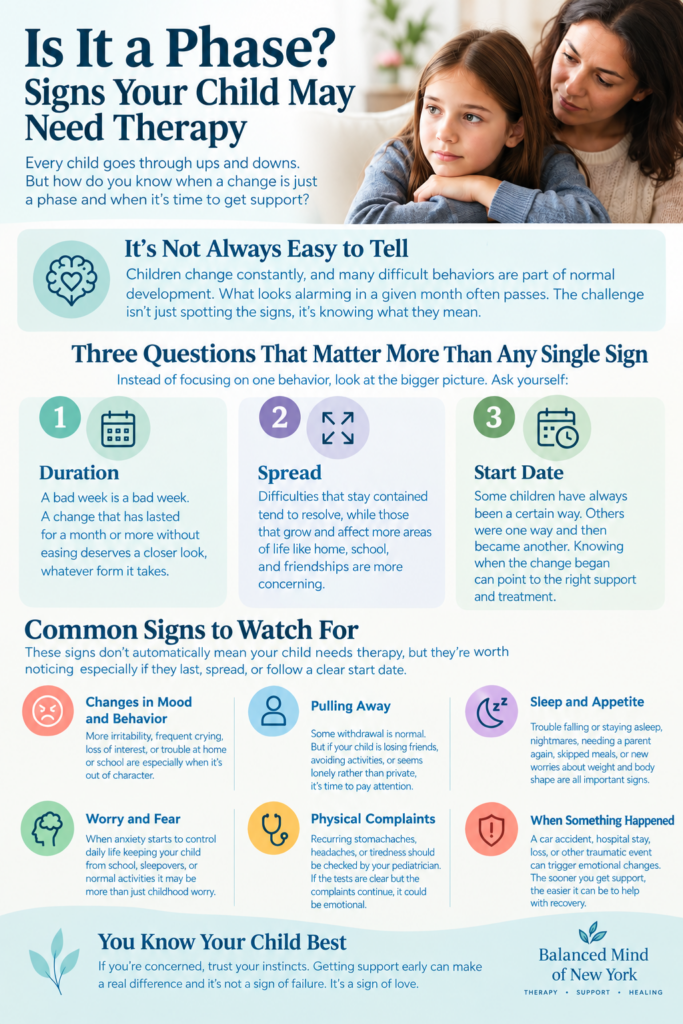
Three questions that matter more than any single sign
The first is duration. A bad week is a bad week. A change that has held for a month or more without easing deserves a closer look, whatever form it takes.
The second is spread. Difficulties that stay contained tend to resolve, and difficulties that grow tend not to. A child who is nervous about one teacher is in a different position from a child whose nervousness has moved from that classroom to school in general, and from school to leaving the house at all. I pay close attention to whether a problem is narrowing over time or broadening, because the direction of travel usually tells you more than how severe things look on any given day.
The third is whether there is a start date. Some children have always been a certain way: more anxious, more intense, slower to settle. Others were one way and then became another, and their parents can name the month, sometimes the day. Both can warrant help. But they are different problems that call for different treatment, and knowing which one you are looking at is half of any good assessment.
Held against those three questions, the familiar signs become much easier to read.
Changes in mood and behavior
Irritability is the sign parents most often miss, because it does not look like distress. A sad or frightened child frequently presents as an angry one, and in older children sadness tends to arrive looking like attitude. A short fuse that was not there before, frequent crying, losing interest in things they used to love, and trouble at home or school that is out of character are all worth noticing. Any one of these on its own means little. Several together, holding for weeks, mean considerably more.
Pulling away
Children grow toward independence, and some withdrawal is part of that. What I look at is what the child is withdrawing from and what they are withdrawing into. A twelve-year-old who spends more time in their room but still texts friends and still goes to practice is growing up. A child who has let friendships lapse that used to matter, stopped wanting to go to the things they used to go to, and seems alone rather than private is telling you something.
Sleep and appetite
Sleep is often the first thing to change after something difficult, and it is the most concrete thing a parent can track. Trouble going down, waking in the night, nightmares, or a child who has not needed a parent’s bed in years suddenly needing it again are all meaningful.
Changes in eating matter too. Skipped meals, secretive eating, or new remarks about weight and body shape are not things to wait out. If you are seeing them, raise them with your pediatrician promptly.
Worry and fear
Some worry belongs to childhood. The question is whether it has started running the child’s life: keeping them from school, from sleepovers, from parts of the day other children move through without thinking.
It also helps to notice what the fear is attached to. A child whose anxiety centers on something specific- a dog, a car, a doctor’s office, an afternoon they can point to- is often in a different situation from a child who has worried about nearly everything since they were small. The first kind of anxiety frequently has a memory underneath it. The second usually does not, and it tends to respond best to a different kind of treatment.
Physical complaints without a physical cause
Younger children in particular often feel distress in their bodies before they can put it into words. Recurring stomachaches, headaches, or tiredness deserve a medical look first, and your pediatrician is the right place to start. When that comes back clear, and the complaints keep clustering around school mornings or particular situations, it is reasonable to consider that the body is carrying something the child cannot yet say.
When something happened
This is the category I most want parents to take seriously, because it is where waiting costs the most and where treatment is often shortest.
A car accident. A dog bite. A hospital stay, a frightening procedure, a bad fall. Witnessing something violent, or seeing a parent get hurt. Parents often decide these events were not serious enough to count, particularly when nobody was badly injured. But how bad an event looks from the outside is a weak predictor of what it does to a particular child. How close they were to it matters. What they believed was about to happen matters. How the adults around them reacted matters.
Most children recover from frightening events on their own, with time and steady adults around them, and the disturbed sleep and clinginess of the first few weeks are a normal response rather than a disorder. What warrants an assessment is a reaction that has not settled after about a month, or avoidance that keeps spreading outward from the original event. The fear of the one dog becomes a fear of all dogs, and then of going outside.
When a single event is driving the symptoms in an otherwise supported child, treatment is often brief. In controlled trials of trauma-focused therapy after a single incident, most children no longer met criteria for post-traumatic stress disorder after six sessions or fewer.
What it looks like in a teenager
Adolescents tend to present differently. Distress shows up as irritability and anger more often than visible fear, as withdrawal, as sleep going wrong in one direction or the other, as grades sliding without an explanation, as risk-taking or drinking that is out of character. The underlying difficulty frequently surfaces first as something else, and the depression or the behavior at school is what gets noticed while the cause sits underneath it.
Many teenagers have also already told their parents, one way or another, that they will not talk to anyone. In my experience, that refusal is usually about a particular kind of therapy, or a particular therapist, rather than about help in general. It is worth separating the two before concluding that nothing is available.
Signs that should not wait
Everything above is a matter of judgment over weeks. Some things are not.
If your child talks about wanting to die or not wanting to be here, is hurting themselves, seems to have lost touch with what is real, or is putting themselves in serious danger, that calls for help today rather than a consultation next month. Contact your child’s pediatrician or clinician the same day, call or text 988 to reach the Suicide and Crisis Lifeline, or go to the nearest emergency room if you believe your child is in immediate danger. Once the immediate crisis has passed, that is the point to set up ongoing treatment, rather than something to put off until things feel calmer.
What therapy for a child actually involves
Therapy with children is not adult therapy in a smaller chair. With a five-year-old, the work is largely visual and physical, carried by drawing, play, and the body rather than by conversation. With a teenager it looks much closer to adult treatment, and the young person’s privacy becomes part of what makes it work. Parents are part of it at every age, though the shape of that involvement changes: often in the room throughout with young children, at the start and end of sessions as children get older, and at check-ins and in the background with adolescents.
What the treatment should be depends on what the assessment finds. For most anxious children, cognitive behavioral therapy with gradual exposure has the strongest evidence and is usually the right place to start. For children struggling after a traumatic event, trauma-focused cognitive behavioral therapy and EMDR are both strongly recommended by the international treatment guidelines. Trauma-focused CBT has the larger body of research behind it. EMDR has the practical advantage of not requiring the child to describe what happened in detail, which matters a great deal for children who cannot or will not.
Some difficulties are better treated with the family than with the child alone. When conflict at home has become part of what keeps a problem going, or when a young child’s separation anxiety is being sustained by the pattern between parent and child, family therapy often gets further than individual sessions can. It can also run alongside a child’s own treatment rather than replacing it.
For teenagers whose emotions have become intense enough to put them at risk, including those who are self-harming, dialectical behavior therapy adapted for adolescents has good evidence behind it. It teaches concrete skills for tolerating distress and regulating emotion, and the adolescent version brings parents into the skills work too, so the household learns the same language the teenager does.
One more thing is worth saying plainly. A good first assessment should be as willing to conclude that your child does not need therapy, or needs something other than what that clinician offers, as it is to recommend treatment. If a consultation cannot end with “wait and watch” or “this is not the right fit,” it is not really an assessment.
What you can do in the meantime
Two instincts are common and neither helps much: avoiding the subject entirely to protect the child, or pressing them to talk about it until they do. The more useful posture is availability without pressure. Let your child raise things, answer honestly when they do, and keep routines as steady as you can.
It also helps to keep a few notes. When the change started, what seems to make it better or worse, and whether it is narrowing or spreading. Those three things are exactly what a clinician will ask about, and parents’ memories of the timeline tend to blur once they are worried.
Pay some attention to your own reaction as well. Children read the adults around them closely, and a parent who is visibly alarmed tends to confirm a child’s sense that something is badly wrong. That is not a reason to hide your concern, only to carry it somewhere other than in front of them.
If you are still not sure
You do not need to be certain before you reach out. Being uncertain is a perfectly good reason for a consultation, and it is the most common one.
At Balanced Mind Psychotherapy, our clinicians working with young people include a marriage and family therapist, clinicians trained in dialectical behavior therapy, and an EMDR clinician who sees children and adolescents from age five upward. We work on the Upper East Side and virtually across New York State. If you are trying to work out whether what you are seeing is a phase, you are welcome to reach out for a consultation, including one that ends with the advice to wait, or with a referral to something that fits your child better.
Frequently asked questions
How long should I wait before getting my child evaluated?
For most changes in mood, sleep, or behavior, about a month is a reasonable point to reassess. If the change has held or is spreading into more areas of your child’s life, it is worth getting an assessment. Anything involving self-harm, talk of dying, or immediate danger should not wait at all.
My child has always been anxious. Is that something therapy can help with?
Often, yes. Long-standing anxiety without a clear starting point usually responds best to cognitive behavioral therapy with gradual exposure, which has the strongest evidence for anxious children. Anxiety that began after a specific event is a somewhat different problem and may call for a different approach.
Is my child too young for therapy?
Children can benefit from therapy from early childhood, though with very young children much of the work often happens through the parents. Our EMDR clinician works with children from age five upward.
My teenager refuses to go. What can I do?
A refusal of one therapist or one kind of therapy is not the same as a refusal of all help. It is often useful for a parent to have a first consultation alone, to describe what they are seeing and get an honest read on whether treatment is likely to help. Some teenagers are more willing once they know what the therapy would actually ask of them and what would stay private.
Should I start with the pediatrician?
For physical complaints like stomachaches, headaches, or fatigue, yes, since medical causes should be ruled out first. Your pediatrician can also be a useful second opinion on whether a change in your child is within the normal range, and can refer you onward if it is not.
What is DBT, and is it right for my teenager?
Dialectical behavior therapy is a skills-based treatment for people whose emotions are intense enough to cause them real harm. The adolescent version has good evidence for teenagers who are self-harming or whose emotional swings are driving dangerous behavior, and it involves parents in learning the skills alongside their teenager. For a teenager whose difficulties center on a specific frightening event, a trauma-focused treatment is usually the better starting point.
When is family therapy the better choice?
When the difficulty is being kept going by what happens between family members rather than only by what is happening inside the child. Persistent conflict at home, a young child’s separation anxiety, and problems that ease at school but flare at home are common examples. Family therapy can also sit alongside a child’s individual treatment.
Will I be involved in my child’s therapy?
Yes, though how depends on your child’s age. Parents of young children are often in the room for much or all of a session. With older children, involvement usually narrows to the beginning and end of sessions. With teenagers, you can expect updates on how treatment is going and on any safety concerns, while the content of sessions generally stays private. In family therapy, of course, you are part of every session.