
How Can Neurodiverse Couples Counseling Help My Relationship?
Every relationship has its ups and downs. Partners argue, misread each other, and sometimes struggle to feel truly heard. When one or both partners are neurodivergent, these everyday challenges can look a little different. Differences in communication style, sensory needs, or executive functioning can lead to misunderstandings that leave both people feeling frustrated or alone. An experienced couples therapist who understands neurodiversity affirming care can help you and your partner build clearer communication, deeper connection, and more patience with each other’s differences.
At Balanced Mind Psychotherapy, we offer couples therapy for a wide range of relationship concerns, including those faced by neurodivergent couples. Our therapists help you and your partner learn to resolve conflicts in a healthy way that supports harmony at home. Whether you are newly navigating a neurodivergent diagnosis together or have been working through these patterns for years, we are here to help. Schedule a free consultation today to see how neurodiverse couples counseling can support your relationship.
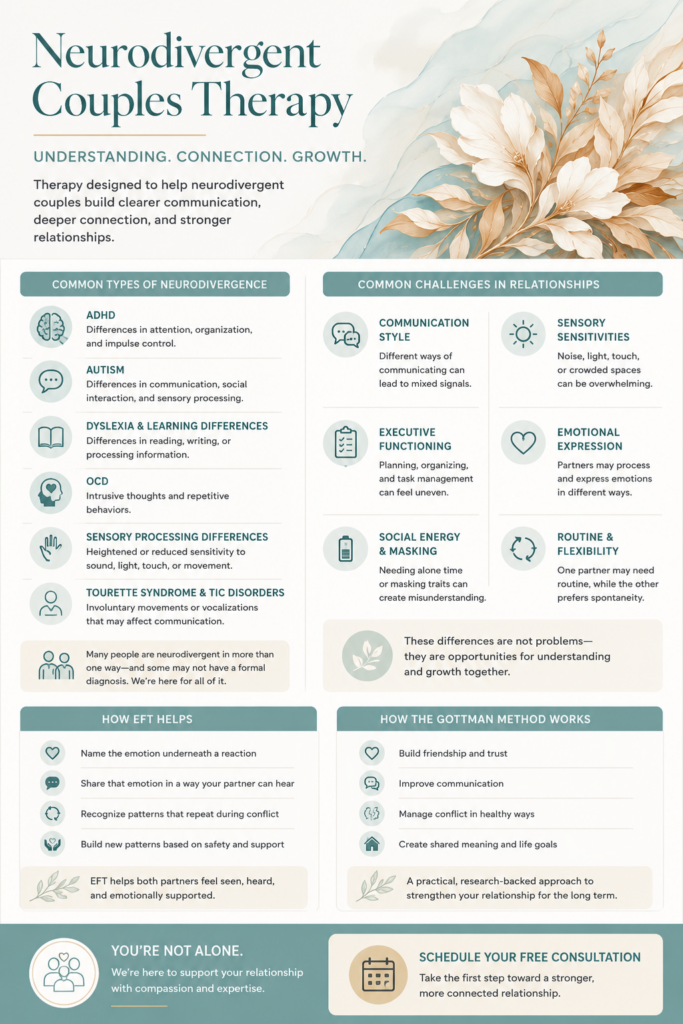
What Types of Neurodivergence Are Common in Couples Therapy?
Neurodivergence includes a wide range of conditions that affect how a person thinks, communicates, and experiences the world. In neurodivergent couples therapy, we often work with partners who are navigating one or more of the following:
ADHD. Differences in attention, organization, and impulse control that can affect shared tasks and routines.
Autism. Differences in communication style, social interaction, and sensory processing.
Dyslexia and other learning differences. Differences in reading, writing, or processing information that can affect communication at home.
Obsessive Compulsive Disorder (OCD). Intrusive thoughts and repetitive behaviors that can shape daily routines and decision-making.
Sensory Processing Differences. Heightened or reduced sensitivity to sound, light, touch, or movement.
Tourette Syndrome and Tic Disorders. Involuntary movements or vocalizations that may affect communication or social situations.
Many people are neurodivergent in more than one way, and some partners may not have a formal diagnosis at all. Neurodivergent couples therapy is built to support a wide range of experiences, whether one partner, both partners, or neither partner has a specific diagnosis.
What Neurological Differences Can Be Challenging for Couples?
Neurodivergent couples often navigate a specific set of differences that can shape daily life together. Understanding these differences is often the first step toward working through them. Some of the most common challenges include:
Communication style. One partner may prefer direct, literal language while the other relies more on tone or nonverbal cues, which can lead to mixed signals.
Sensory sensitivities. Noise, light, touch, or crowded spaces may affect one partner more than the other, which can shape decisions about socializing or home environment.
Executive functioning. Differences in planning, organizing, or starting tasks can create uneven division of household responsibilities.
Emotional expression and regulation. Partners may process and express big emotions differently, which can make conflict feel more intense or confusing.
Social energy and masking. One partner may need more time alone to recharge after socializing, or may mask certain traits in public, which can be tiring and hard to explain to a partner.
Routine and flexibility. One partner may rely on predictable routines while the other is comfortable with spontaneity, which can create friction around plans and change.
None of these differences are a sign that a relationship is broken. They are simply areas where extra understanding and clear communication can make a real difference. A therapist experienced in neurodiverse relationships can help you and your partner name these patterns and build strategies that work for both of you.
How Does EFT Help Neurodiverse Couples?
Emotionally Focused Therapy, or EFT, is a structured approach to couples therapy that focuses on the emotional bond between partners. The goal is to help each person understand the feelings behind their reactions, and to help both partners respond to each other with more warmth and safety.
For neurodiverse couples, EFT can be especially helpful because it slows down conversations that might otherwise move too fast or become overwhelming. A therapist trained in EFT helps each partner:
- Name the emotion underneath a reaction, such as feeling dismissed or overstimulated
- Share that emotion in a way the other partner can hear and understand
- Recognize patterns that repeat during conflict, like withdrawing or shutting down
- Build new patterns based on emotional safety and support
This approach supports emotional regulation for both partners, which is often a key piece of neurodivergent couples therapy. When each person feels safer expressing what they need, conflict becomes less about blame and more about understanding.
How Can the Gottman Method Work In Neurodiverse Couples Therapy?
The Gottman Method is a well-researched approach to couples counseling that focuses on friendship, conflict management, and shared meaning in a relationship. It relies on practical tools and exercises rather than abstract concepts, which many neurodivergent couples find helpful.
In neurodivergent couples therapy, the Gottman Method can offer:
- Clear, direct communication tools that reduce guesswork during disagreements
- Structured exercises for expressing appreciation and repairing after conflict
- Techniques for managing flooding, which is when a conversation becomes too emotionally intense to continue productively
- A framework for identifying each partner’s needs, love languages, and daily habits
Because this method leans on concrete steps rather than open-ended conversation, it often fits well with the communication style of neurodiverse relationships. Partners can practice these tools together at home, which builds consistency between sessions.
How Is CBT Used In Couples Counseling for Neurodiverse Relationships?
Cognitive Behavioral Therapy, or CBT, focuses on the connection between thoughts, feelings, and behaviors. In couples counseling, CBT helps partners notice unhelpful thought patterns that may be adding stress to the relationship, such as assuming the worst about a partner’s intentions.
For neurodiverse relationships, CBT can help with:
- Identifying thought patterns that lead to conflict or misunderstanding
- Building coping strategies for sensory overwhelm or emotional flooding
- Improving executive functioning skills that support daily routines as a couple, like managing shared responsibilities
- Replacing assumptions with direct, honest communication
CBT gives couples practical tools they can use outside of sessions, which makes it a strong fit for couples counseling focused on neurodivergent partners.
How Is Neurodivergent Couples Therapy Different From Traditional Couples Counseling?
Traditional couples counseling often assumes both partners communicate, process emotions, and experience social situations in similar ways. Neurodivergent couples therapy takes a different starting point. It recognizes that partners may have different communication styles, sensory needs, or ways of expressing emotion, and it treats those differences as valid rather than something to correct.
A few ways this approach differs from traditional couples counseling include:
Communication expectations. Instead of assuming eye contact, tone of voice, or quick back-and-forth conversation works for everyone, a therapist adjusts the pace and style of sessions to fit both partners.
Focus on differences, not deficits. Traditional counseling may frame certain behaviors as a lack of effort or empathy. Neurodivergent couples therapy looks at these same behaviors through the lens of neurodiversity affirming care, which means understanding them as differences in wiring rather than character flaws.
Practical tools over abstract concepts. Sessions often include concrete strategies for executive functioning, routines, and sensory needs, rather than relying only on open-ended discussion.
Individualized pacing. Some neurodivergent partners need more time to process a question or may prefer written reflection between sessions. Therapy is structured to allow for this instead of expecting quick verbal responses.
The goal is the same as any couples therapy: a stronger, healthier relationship. The path to get there is simply adapted to fit how each partner actually thinks and communicates.
Why Should My Partner and I Consider Couples Therapy?
Couples therapy is not only for relationships in crisis. Many neurodivergent couples come to therapy simply because they want to understand each other better and build a stronger foundation. A therapist trained in working with neurodivergent couples can help you move through common struggles with more confidence and less frustration.
Here are specific ways a therapist can help:
Improving communication. A therapist can help you find a communication style that works for both partners, whether that means more directness, more processing time, or written communication alongside conversation.
Supporting emotional regulation. Learning to recognize and manage big emotions, for both partners, can reduce the intensity of conflict and help you both feel more in control during hard conversations.
Navigating executive functioning differences. Many couples struggle with shared tasks like planning, organizing, or keeping track of responsibilities. A therapist can help you build systems that work for how your household actually functions.
Building mutual understanding. Therapy creates space to talk about sensory needs, social energy, and personal boundaries in a way that helps both partners feel respected.
Strengthening connection. Beyond solving problems, therapy helps couples reconnect and rebuild the friendship at the center of their relationship.
If you and your partner are facing any of these challenges, couples therapy can offer real, practical support.
How Should I Approach My Partner About Seeking Neurodiverse Couples Therapy?
Bringing up couples therapy can feel intimidating, even when both partners want a stronger relationship. How you approach the conversation may look different depending on whether your partner is neurotypical or neurodivergent.
Approaching a Neurotypical Partner
- Focus on the relationship, not blame. Frame therapy as something you want to do together, not something aimed at fixing them.
- Explain that neurodivergent couples therapy is designed to help both partners understand each other, not just address one person’s traits.
- Share a specific example of a recent misunderstanding to show why extra support could help.
- Reassure them that therapy is a space to learn tools together, not a place to be judged.
Approaching a Neurodivergent Partner
- Give them time to think it over. A direct question followed by space to process, rather than an immediate answer, may feel more comfortable.
- Emphasize that therapy will take a neurodiversity affirming care approach, meaning their traits will not be treated as something to fix.
- Explain what a session might look like, since knowing what to expect can ease anxiety about a new experience.
- Ask what would make the process feel safer for them, such as written notes, breaks during sessions, or extra processing time.
In both cases, patience and honesty go a long way. Let your partner know that the goal is a stronger relationship for both of you, not a one-sided change.
Balanced Mind Psychotherapy | Neurodivergent Couples Therapy
At Balanced Mind Psychotherapy, our therapists are experienced in neurodivergent couples therapy and understand the specific needs of neurodiverse couples. We take a neurodiversity affirming care approach, which means we meet you and your partner where you are, without judgment or a one-size-fits-all method. We offer in-person sessions for couples who want a dedicated, focused space to work through challenges together.
Every relationship deserves support that understands its unique dynamics. If you and your partner are ready to build better communication and a stronger connection, we would love to help. Schedule a free consultation with Balanced Mind Psychotherapy today to get started.