
What Is a Couple Gridlock?
Picture two partners at the kitchen table, having the conversation again. One wants to move closer to family. The other has built a career they love right where they are. They’ve circled this before, and it isn’t stubbornness keeping them stuck here—it’s that the conversation keeps brushing up against something they haven’t quite said out loud: whose life gets to come first, and what it would cost the other to bend. Each round leaves them a little more guarded with each other, a little less certain they’re truly being heard. The dilemma itself may not have a clean answer. What can shift is how they carry it together, so the disagreement stops pulling them apart and becomes something they’re facing side by side.
This is a couple gridlock in action. It is one of the most common and painful places a relationship can land, but it is not a dead end. The example couple has circled this issue before, and it isn’t stubbornness keeping them stuck here. It’s that the conversation keeps brushing up against something they haven’t quite said out loud: whose life gets to come first, and what it would cost the other to bend. Each round leaves them a little more guarded with each other, a little less certain they’re truly being heard. The dilemma itself may not have a clean answer. What can shift is how they carry it together, so the disagreement stops pulling them apart and becomes something they’re facing side by side.
A licensed couples therapist can help you and your partner work through the underlying emotions, understand each other more deeply, and build a stronger relationship even when the issue itself does not have an easy answer.
At Balanced Mind Psychotherapy, we provide therapy and counseling for couples who are caught in emotional gridlock. Our therapists understand how exhausting it feels to keep circling the same arguments without resolution, and we are here to help. Whether you are dealing with one recurring conflict or a pattern of disconnection that has built up over time, we would love to support you. Schedule a free consultation today and take the first step toward a healthier relationship.
What Is Emotional Gridlock?
Emotional gridlock is what happens when a couple gets stuck on a perpetual issue, a conflict that doesn’t resolve and keeps resurfacing. Unlike solvable problems, which have practical answers, gridlock forms around topics that touch each person’s identity, deeply held beliefs, or core values: whether to have children, where to live, how to spend money, how close to stay to extended family. These aren’t small disagreements. They’re the kinds of conflicts where agreeing with a partner can feel like giving up a piece of yourself.
What makes emotional gridlock so difficult is that both people are often right from within their own experience. The conflict isn’t really about facts; it’s about meaning. When one partner feels pressured to change their position on something that touches who they are, it tends to trigger hurt, defensiveness, and a sense of being asked to abandon themselves. Over time, the arguments stop being about the original issue and start being about something harder to name: the pain of feeling unseen by the person closest to you.
Emotional gridlock doesn’t mean a relationship is failing. It means two people with different inner worlds haven’t yet found a way to hold space for both of those worlds at the same time. With the right support, that changes.
Fair enough — here’s the version with them split back into separate sections, kept distinct from each other:
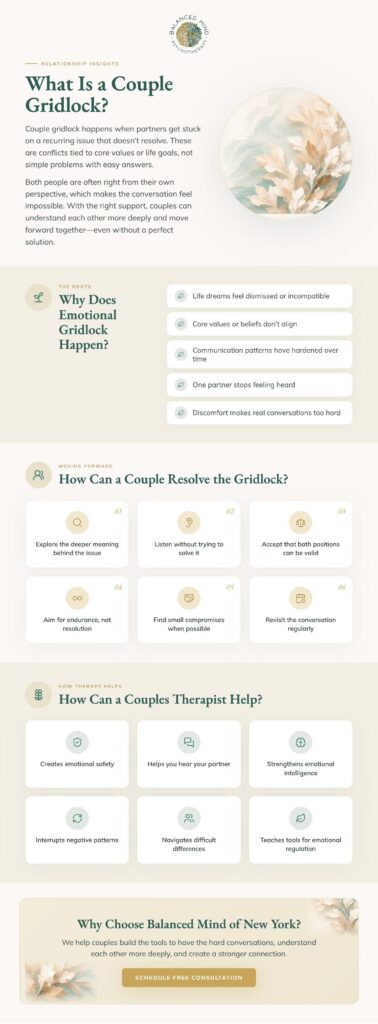
Why Does Emotional Gridlock Happen?
Gridlock rarely comes out of nowhere. It tends to develop when certain emotional and relational patterns go unaddressed over time. Here are some of the most common reasons it takes hold.
A life dream feels dismissed.
When a deeply personal hope or life goal for one partner feels incompatible with the other’s, it creates real tension. These aren’t passing preferences; they’re tied to identity and a sense of purpose. When a partner repeatedly dismisses or minimizes that dream, even gently, it creates emotional distance, and over time, gridlock.
Core values don’t align.
Differences in deeply held beliefs about family, religion, money, parenting, or lifestyle tend to surface as the same argument, again and again. Each person may feel that giving ground means giving up part of who they are, which makes even a temporary compromise feel like a loss rather than a step forward.
Communication patterns have hardened over time.
When couples lack tools for talking about difficult emotions, small frustrations accumulate. Eventually, a pattern sets in where the conversation feels threatening before it even starts. Emotional safety erodes, and the topic gets harder to approach with each attempt.
One partner stops feeling heard.
Gridlock deepens when one partner senses their perspective is never really taken in, only dismissed or argued against. Eventually they stop bringing it up at all. That silence can look like peace, but it usually means the distance is growing.
Discomfort becomes too hard to tolerate.
Real conversations about values require sitting with discomfort: hearing something hard without reacting, staying present when a topic feels threatening. When that capacity is underdeveloped in one or both partners, conversations escalate quickly, or shut down, before any real understanding has a chance to happen.
How Can a Couple Resolve the Gridlock?
Overcoming gridlock isn’t about winning the argument or getting your partner to come around to your side. It’s about creating enough emotional safety that both people can actually be heard. Here are some concrete steps couples can take.
- Explore the deeper meaning behind the issue. Ask yourself why it matters so much to you. What dream, fear, or value is underneath your position? Sharing that story with your partner, rather than just defending your stance, opens a door that arguing never can.
- Practice listening without problem-solving. When your partner shares their perspective, the goal is to understand it, not to respond to it. Asking questions and reflecting back what you heard is one of the most powerful tools for rebuilding connection once distance has become the default pattern between you.
- Acknowledge that both positions can be valid. Gridlock often eases when couples stop treating the conflict as zero-sum. A partner’s position doesn’t have to be wrong for your position to matter, and two people can hold different deeply held beliefs and still love each other.
- Aim for meaningful endurance, not resolution. Not every perpetual issue gets solved. Often the real goal is reaching a place where both partners understand each other well enough to live with the difference without it poisoning the relationship.
- Look for a temporary compromise. Where full resolution isn’t possible, small steps toward accommodation can still reduce tension and give the relationship room to breathe, while signaling good faith.
- Develop your emotional regulation skills. When you can tolerate discomfort without shutting down or escalating, you create more room for genuine dialogue. Practices like mindfulness, journaling, and therapy all build this capacity.
- Revisit the conversation on a regular schedule. Rather than letting the issue fester until it boils over, set intentional time to check in. Knowing there’s a set time and place for the conversation reduces the anxiety that tends to build around it in between.
How Can a Couples Therapist Help With Emotional Gridlock?
Working through relationship gridlock on your own is hard. The same patterns that created the gridlock tend to resurface every time you try to address it yourselves. A couples therapist brings a trained outside perspective and concrete tools that can shift the dynamic. Here is how that support makes a difference.
Building emotional safety.
Before any real progress can happen, both partners need to feel safe enough to be honest. A therapist helps establish ground rules and communication norms that protect that safety. This is often the first shift couples notice, sometimes before the underlying issue has moved at all.
Helping you hear your partner’s perspective.
When you’re deep inside your own hurt feelings, it’s genuinely hard to take in what your partner is actually saying. A therapist slows the conversation down, often putting words to what’s underneath a partner’s position so the other person can finally hear it as something other than an attack. For many couples, that’s the first time they truly receive each other’s perspective.
Strengthening emotional intelligence.
Emotional intelligence, the ability to identify, understand, and manage emotions, is at the heart of overcoming gridlock. Therapy helps both partners develop a steadier, more grounded sense of self: knowing who you are and what you value without needing your partner to confirm it or agree with every part of it.
Interrupting negative patterns.
A therapist helps you see the cycle you’re in. Couples are often caught in a pattern they can’t identify on their own, simply because they’re too close to it. Once the cycle becomes visible, it becomes possible to interrupt.
Navigating what might look like irreconcilable differences.
Not every difference is truly irreconcilable. But even when a couple is facing a genuine values gap, therapy can help them find a path forward that doesn’t require either person to abandon their core sense of self. The goal isn’t sameness. It’s understanding.
Offering tools for emotional regulation.
When emotions run high, conversations break down. Therapists teach practical regulation skills, including how to recognize escalation early, how to take a break that actually helps, and how to return to the conversation more open than when you left it.
Why Should I Choose Balanced Mind Psychotherapy?
At Balanced Mind Psychotherapy, we believe that being stuck does not mean being broken. The couples who come to us are usually doing their best with tools that aren’t working anymore, not failing at love, just stuck in patterns neither of them chose on purpose. Our therapists bring warmth, clinical skill, and genuine care to every session.
We specialize in helping couples build the emotional tools they need to have the conversations that matter most. Whether you’re circling the same argument for the fifth year running, feeling the distance that comes from years of unaddressed gridlock, or simply want to understand your partner more deeply, we’re here for all of it.
Our approach is grounded in evidence-based methods and shaped around who you are as a couple, not a script we apply to everyone. We meet you where you are, help you understand each other more deeply, and walk with you toward a relationship that feels more connected and more sustainable.
You don’t have to keep having the same fight. Reach out to Balanced Mind Psychotherapy today and schedule your free consultation. A different kind of conversation is possible.