
Are You and Your Partner Stuck in a Loop?
Picture this: one partner brings up a concern about the relationship. The other shuts down, goes quiet, or leaves the room. The first partner pushes harder to be heard. The other withdraws further. Nothing gets resolved, and both partners walk away feeling unheard and a little more distant than before.
If this sounds familiar, you may be caught in what researchers call the demand-withdraw pattern, one of the most common and damaging communication cycles in romantic relationships. Left unaddressed, it can quietly erode trust and connection over time. The good news is that the cycle is breakable. Couples therapy can offer practical communication tools and a safe space to work through the pattern together.
At Balanced Mind Psychotherapy, our therapists have extensive experience helping couples navigate difficult relationship dynamics, including demand-withdraw. We specialize in emotionally focused therapy (EFT), an evidence-based approach that addresses the root of communication breakdowns and helps partners rebuild secure, lasting connection. Whether you’ve been together for two years or twenty, our compassionate team is here to help. Schedule a free consultation today to take the first step.
What Is the Demand-Withdraw Pattern?
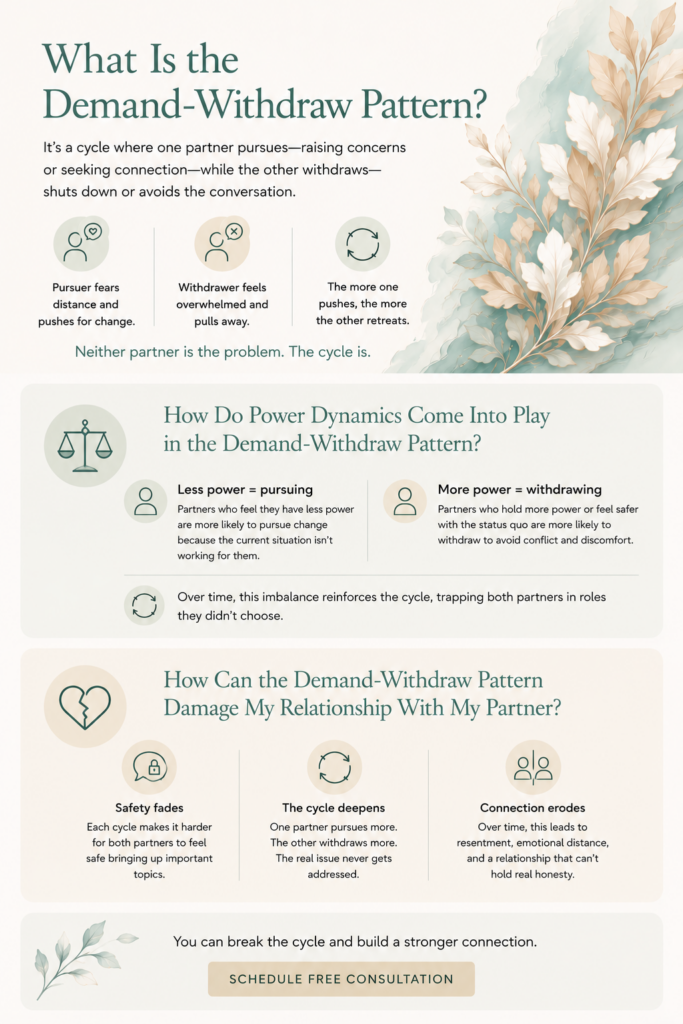
The demand-withdraw pattern is a communication cycle in which one partner, the pursuing partner, repeatedly raises concerns, asks for change, or seeks emotional connection, while the other, the withdrawing partner, pulls back, goes silent, or avoids the conversation altogether.
This pattern is well documented in relationship research and consistently linked to lower relationship satisfaction for both partners. It isn’t a matter of one person being difficult. The pursuing partner often fears emotional distance and uses persistence as a way to stay connected. The withdrawing partner may feel overwhelmed, criticized, or inadequate, and pulls back as a way to manage that discomfort.
Neither role is really the problem. The cycle is. The more the pursuing partner pushes, the more the withdrawing partner retreats, and the more the withdrawing partner retreats, the harder the pursuing partner pushes. Both end up feeling stuck, and the conversation that actually needs to happen keeps getting further out of reach.
This pattern shows up across all kinds of relationships, regardless of gender or relationship structure, which suggests it has more to do with emotional dynamics than with who someone is.
How Do Power Dynamics Come Into Play in the Demand-Withdraw Pattern?
Power dynamics often shape who ends up pursuing and who ends up withdrawing. Partners who feel they have less power in the relationship, whether due to financial dependence, emotional investment, or other factors, are more likely to take on the pursuing role. They push because the current situation isn’t working for them, and something needs to change.
The partner who holds more perceived power, or who benefits more from the current dynamic, is more likely to withdraw, since maintaining the status quo feels safer. This doesn’t mean the withdrawing partner is choosing to be emotionally unavailable. Often, they genuinely feel unable to handle the intensity of the conflict and shut down as a way to cope.
Over time, this imbalance can reinforce itself. The pursuing partner grows more desperate to be heard, which escalates the pursuit. The withdrawing partner becomes more entrenched in avoidance. Both end up trapped in roles neither of them consciously chose.
How Can the Demand-Withdraw Pattern Damage My Relationship With My Partner?
The demand-withdraw cycle doesn’t just cause arguments. It gradually wears down the foundation of a relationship.
Each time the cycle plays out without resolution, both partners feel less safe bringing up vulnerable topics. The pursuing partner learns that pushing leads to more distance. The withdrawing partner learns that conversations lead to conflict. Connection erodes on both sides.
The pattern also becomes self-reinforcing. One partner feels unheard, so they pursue more urgently. The other feels criticized or overwhelmed, so they withdraw more completely. The original issue never gets addressed, and both partners end up feeling more alone than before.
Left unaddressed long enough, demand-withdraw can lead to emotional estrangement, resentment, and a growing sense that the relationship can’t hold real honesty.
How Can We Break Out of the Demand-Withdraw Pattern?
Breaking the cycle takes both partners recognizing their role in it and making intentional changes. It takes practice and patience, and often some outside support, but it’s absolutely possible.
Name the pattern together. When both partners can recognize and name the cycle as it’s happening, something like “I think we’re in the loop again”, it creates a moment of shared awareness instead of blame.
The pursuing partner slows down. Instead of pushing harder, try naming the vulnerability underneath the request. “I miss you, and I’m scared we’re drifting apart” lands very differently than “You never want to talk to me.”
The withdrawing partner stays in the room. Even saying “I feel overwhelmed right now, but I don’t want to shut you out” communicates care instead of avoidance.
Choose the right time. Avoid raising sensitive topics when either partner is exhausted, hungry, or distracted. Both of you are more likely to stay regulated when you’re not already running on empty.
Take breaks with intention. If emotions run too high, agree to pause for 20 to 30 minutes and return to the conversation rather than letting it drop entirely.
Practice softer start-ups. Opening with criticism or urgency raises defenses immediately. A calm, specific, non-blaming opener gives both partners a better chance of staying connected through the conversation.
Focus on the cycle, not each other. Emotionally focused therapy encourages couples to treat the pattern itself as the problem, not their partner. You’re both caught in the same cycle together.
Do We Need a Couples Therapist To Help Us Stop the Demand-Withdraw Pattern?
Not every couple needs therapy to shift their communication. Some make meaningful progress with self-awareness, good resources, and real commitment to change. But for many couples, the pattern is entrenched and emotionally charged enough that outside support makes a real difference.
Creating a safe space for both partners. Many couples find it hard to have honest conversations at home without one or both shutting down. A therapist offers a neutral, structured environment where both people feel safer speaking and listening.
Helping you recognize your triggers. A skilled therapist helps each partner understand what specifically activates their pursuing or withdrawing response. Seeing your own pattern clearly gives you more choice in how you respond.
Teaching practical communication tools. Therapists trained in EFT work directly on the cycle itself, helping couples interrupt the pattern in real time and practice new ways of connecting.
Addressing deeper attachment needs. Demand-withdraw is often rooted in unmet attachment needs, including fears of abandonment or not being enough. Therapy helps partners recognize and communicate these needs in ways that actually bring them closer.
Maintaining progress over time. Knowing something intellectually and changing an ingrained pattern are two different things. A therapist helps you track progress and work through setbacks as they come.
Why Should We Choose Balanced Mind Psychotherapy?
At Balanced Mind Psychotherapy, we understand that reaching out for couples therapy takes courage. We approach every relationship with care, curiosity, and no judgment.
Our therapists specialize in emotionally focused therapy, one of the most well-researched models for addressing the demand-withdraw pattern and similar relationship dynamics. EFT focuses on the emotional bond between partners and helps you build a more secure, resilient connection, not just better arguing techniques.
We work with couples at every stage, from those in early conflict to those who feel they’ve been stuck for years, and we welcome all couples, including same sex couples, with experience in the unique dynamics each relationship brings.
No matter how long you’ve been in the cycle, it isn’t too late to break it. Real change is possible, and you don’t have to figure it out alone.
Schedule your free consultation with Balanced Mind Psychotherapy today and take the first step toward a healthier, more connected relationship.