
What Is Protest Behavior and How Is It Affecting My Relationship?
Imagine this: it’s Tuesday evening, and you’ve just had a long, draining day at work. You come home hoping to decompress, but within minutes, a small disagreement with your partner spirals. They go quiet, retreat to another room, and stop responding to your attempts to talk. You’re left feeling confused, hurt, and more disconnected than ever. Meanwhile, your partner is texting friends, pointedly ignoring yours. Neither of you wants to feel this way, but neither of you knows how to stop it.
This cycle has a name: protest behavior. And it’s more common than most people realize.
At Balanced Mind Psychotherapy, we offer couples therapy to help partners understand and put a stop to protest behavior so they can build stronger, more fulfilling relationships grounded in real communication. Whether you’ve been stuck in this pattern for years or are just starting to notice it, our therapists are here to help. Schedule a free consultation today to take the first step toward a healthier relationship.
What Is Protest Behavior?
Protest behavior refers to the actions people take when they feel emotionally disconnected from, or threatened by the loss of closeness with, an important relationship partner. The concept comes from attachment theory, originally developed by psychologist John Bowlby and later expanded to adult relationships by researchers Cindy Hazan and Phillip Shaver.
At its core, protest behavior is driven by the attachment system, the part of us that monitors the safety and availability of our close relationships. When that system detects a perceived threat to the bond, whether real or imagined, it can trigger behaviors aimed at restoring connection or getting a partner’s attention.
In children, this looks like crying, clinging, or tantrums when separated from a caregiver. In adults, it’s more varied and often subtler, but the underlying drive is the same: re-establish closeness, get a response, and ease the anxiety that comes from feeling cut off.
The tricky part is that adult protest behavior often backfires. Instead of drawing a partner closer, it tends to push them further away, creating a painful cycle that can be hard to break without support.
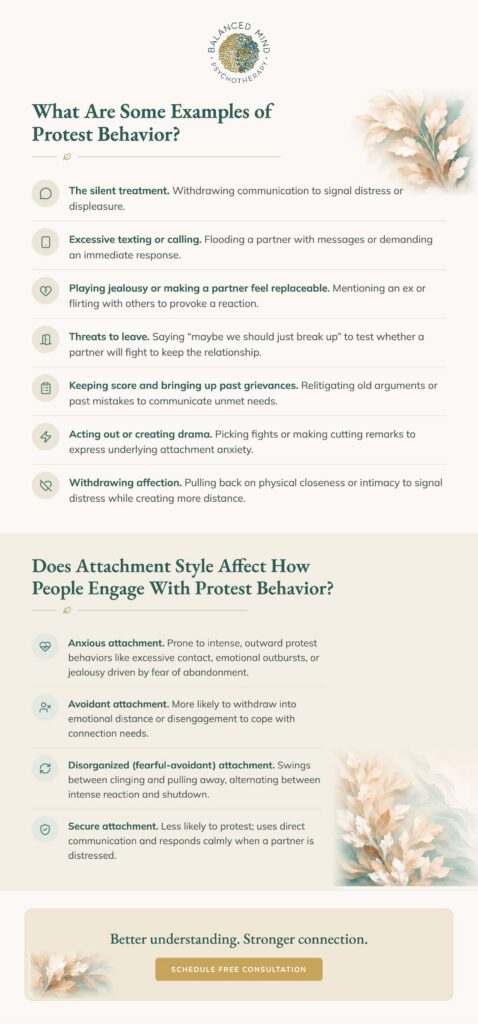
What Are Some Examples of Protest Behavior?
Protest behaviors look different from person to person. Some are passive, others are direct or even aggressive. Here are some of the most common examples that show up in adult relationships.
The silent treatment. Withdrawing communication as a way of signaling distress or displeasure. On the surface, it may look like indifference, but it’s almost always an attempt to provoke a response or signal emotional pain.
Excessive texting or calling. On the other end of the spectrum, some people respond to perceived distance by flooding a partner with messages. Sending unanswered texts, repeatedly calling, or demanding an immediate response are all ways the nervous system tries to reestablish contact and ease attachment anxiety.
Playing jealousy or making a partner feel replaceable. Mentioning an ex, flirting with others in front of a partner, or casually suggesting other options exist are protest behaviors designed to provoke a reaction and restore a sense of being valued.
Threats to leave. Saying things like “maybe we should just break up” during an argument, without truly meaning it, is a form of protest aimed at testing whether a partner will fight to keep the relationship.
Keeping score and bringing up past grievances. Relitigating old arguments or cataloging a partner’s past mistakes mid-conflict is another way the attachment system tries to communicate unmet needs, even as it derails the actual conversation.
Acting out or creating drama. Picking fights over small things, making cutting remarks, or reacting in ways that seem disproportionate to the situation can all be expressions of underlying attachment anxiety rather than anger about the issue at hand.
Withdrawing affection. Pulling back on physical closeness, avoiding touch, moving to the other side of the bed, or declining intimacy, is a quieter form of protest that signals distress while creating more distance.
Does Attachment Style Affect How People Engage With Protest Behavior?
Yes, significantly. Attachment styles, patterns formed in early childhood through our relationships with caregivers, shape how we relate to partners throughout adulthood, including how we engage in protest behavior.
Anxious attachment. People with an anxious attachment style are most prone to frequent, intense protest behavior. Perceived threats to the relationship trigger a strong activation of the attachment system, often showing up as outward forms of protest like excessive contact, emotional outbursts, or jealousy-inducing behavior aimed at restoring closeness quickly. Fear of abandonment is a core driver, which is part of why the urge to protest can feel so urgent.
Avoidant attachment. People with avoidant attachment tend to suppress or minimize their attachment needs, so their protest behavior often looks like withdrawal rather than pursuit, the silent treatment, emotional distance, or disengaging from the relationship altogether. The underlying need for connection is still there, but it’s harder to recognize as protest at all.
Disorganized (fearful-avoidant) attachment. This style combines elements of both anxious and avoidant attachment, often producing unpredictable protest behavior, swinging between clinging and pulling away, or alternating between intense reaction and complete shutdown. This can be especially confusing for a partner trying to understand what’s happening.
Secure attachment. People with a secure attachment style have a more stable attachment system and are generally less likely to resort to protest behavior. When they feel disconnected, they’re more able to use direct communication to express their needs, and they’re better equipped to recognize and respond calmly when a partner is protesting.
It’s worth noting that even securely attached people may engage in some protest behavior under enough stress. Attachment styles exist on a spectrum and can shift over time with self-awareness and the right support.
How Does Protest Behavior Impact Relationships?
Protest behavior is, at its heart, a bid for connection. But as a regular pattern, it can do real damage.
It escalates conflict. What starts as a small misunderstanding can quickly become a full-blown argument once one or both partners are in protest mode. Bringing up past grievances or threatening to leave pours fuel on a fire that was already manageable.
It erodes trust. Repeated exposure to a partner’s protest behaviors, especially the more hurtful ones, creates an accumulating sense of emotional unsafety. Over time, both people may start to feel like the relationship itself is unstable.
It creates painful cycles. In many relationships, one partner’s anxious attachment triggers the other’s avoidant response, and vice versa. The partner on the receiving end withdraws to regulate their own nervous system, which intensifies the protesting partner’s anxiety and produces more protest behavior. This anxious-avoidant loop is one of the most common and exhausting patterns in relationships.
It gets in the way of real communication. Protest behavior is an indirect way of expressing emotional needs. When someone gives the silent treatment instead of saying “I felt hurt when that happened,” or threatens to leave instead of saying “I’m scared we’re drifting apart,” the real message never actually lands. Partners end up reacting to the behavior instead of the need underneath it.
It can lead to emotional disconnection. Over time, unaddressed protest behavior leaves both partners feeling chronically misunderstood and emotionally exhausted, and can chip away at the foundation of even a strong relationship.
How Do I Stop My Own Protest Behavior?
Recognizing your own protest behavior is a meaningful first step, and it isn’t always easy. These patterns are usually deeply ingrained and feel automatic in the moment.
Learn to recognize your triggers. Pay attention to what tends to set off your protest behavior. Is it when your partner seems distracted? When they need space? When plans change unexpectedly? Identifying your triggers creates a small pause between stimulus and response.
Name what you’re actually feeling. Protest behavior is often a cover for more vulnerable emotions like fear, sadness, or loneliness. When you feel the urge to withdraw or escalate, ask yourself what’s actually underneath it.
Practice regulating your nervous system before responding. When your attachment system is activated, your nervous system is in a heightened state. A few slow breaths, a short walk, or grounding yourself physically can help bring you back to baseline before you respond.
Replace protest behavior with direct communication. Instead of sending five unanswered texts, try “I’m feeling disconnected from you, and I miss you.” Instead of going silent, try “I need a little time to collect my thoughts, but I want to talk about this with you.” Direct communication is harder in the moment but far more effective.
Be patient with yourself. These patterns developed over a lifetime and won’t disappear overnight. Noticing your own protest behavior without judgment is already meaningful progress.
Consider working with a therapist. Individual therapy can help you understand your attachment style and develop healthier ways of managing attachment anxiety. Couples therapy adds the dimension of working through these patterns together.
How Should I Respond to Protest Behavior From My Partner?
Being on the receiving end of protest behavior is genuinely difficult. It can feel manipulative, confusing, or hurtful, even once you understand your partner isn’t acting from malice but from distress.
Try not to match the energy. If your partner is escalating, the most helpful thing you can do is stay regulated. That doesn’t mean suppressing your own feelings, just not adding fuel to the fire.
Look for the need underneath the behavior. Ask yourself what your partner is actually trying to communicate. Even if the way they’re expressing it is hurtful, there’s almost always a real emotional need beneath it.
Acknowledge their feelings without endorsing the behavior. You can say something like “I can see you’re really upset, and I want to understand what’s going on” without accepting mistreatment or pretending the behavior is okay.
Set gentle limits when needed. It’s reasonable to say, “I want to talk about this with you, but I need us to talk calmly. Can we take a short break and come back to this?” This communicates care without shutting down the conversation entirely.
Avoid taking the bait on provocative behaviors. If your partner is trying to make you jealous or pushing your buttons on purpose, try not to react to the surface-level behavior. Responding to the provocation rarely helps and often makes things worse.
Bring it up when things are calm. Once you’ve both settled, it can be valuable to revisit what happened, not to assign blame, but to understand what each of you was experiencing and what you both need.
Seek support if the patterns feel unmanageable. Repeated cycles of protest behavior wear on both partners. Couples therapy provides a structured, safe space to work through these patterns with professional guidance.
How Can a Couples Therapist Help My Partner and Me Stop Protest Behavior In Our Relationship?
Working with a couples therapist can be genuinely transformative for partners stuck in cycles of protest behavior. A skilled therapist doesn’t take sides or tell you who’s right. Instead, they help both of you understand what’s driving the pattern and how to interrupt it.
Attachment-based therapy. By helping both partners understand their own attachment styles and how those styles interact, a therapist can shed light on why certain situations trigger protest behavior, taking some of the mystery and blame out of confusing patterns.
Emotionally Focused Therapy (EFT). EFT is one of the most well-researched approaches for couples and works directly with the emotional patterns and attachment needs that drive protest behavior. Therapists help partners identify their negative cycle, access the vulnerable emotions underneath it, and begin responding to each other in new, more connecting ways.
Communication skills training. Therapists teach practical skills for expressing emotional needs clearly and listening in ways that make a partner feel heard rather than defensive, including “I” statements, active listening, and how to pause and re-engage productively during conflict.
De-escalation strategies. Therapists help couples develop agreed-upon ways to manage moments when emotions run high, such as planned pauses with a clear re-engagement plan, so that taking a break doesn’t itself become a form of protest.
Building emotional safety. Much of the work in couples therapy involves creating enough safety that both partners feel they can express their emotional needs directly, without needing to resort to indirect protest behavior.
Identifying and shifting negative cycles. Therapists help couples see the bigger pattern they’re caught in, often an anxious-avoidant loop, so that instead of experiencing each other as the problem, they can face the pattern together.
Rebuilding secure attachment. Over time, the goal of therapy is to help both partners move toward a more secure way of relating, where the bond feels strong enough that perceived threats are less destabilizing and connection can be restored through direct communication.
Why Should I Choose Balanced Mind Psychotherapy?
At Balanced Mind Psychotherapy, we believe strong relationships are built on real understanding, not just good intentions. Protest behavior can make even two people who genuinely love each other feel like strangers, but with the right support, those patterns can change.
Our therapists bring warmth, clinical expertise, and a deep understanding of attachment theory to every session. We work with couples at all stages, whether you’re newly together and noticing early warning signs, or years into a relationship that has felt stuck for a long time. We offer a non-judgmental, compassionate space where both partners feel heard and real, lasting change becomes possible.
We understand that reaching out for help takes courage, which is why we offer a free initial consultation so you can get a feel for our approach and ask any questions before committing to the process.
If protest behavior is creating distance in your relationship, you don’t have to keep navigating it alone. Schedule your free consultation with Balanced Mind Psychotherapy today and take the first step toward a more connected, communicative, and fulfilling relationship.